Whenever I point my trusty 4-inch refractor telescope toward the distant outer reaches of the solar system, the seventh planet presents a notoriously difficult challenge. While I have successfully observed the ice giant as a faint, pale blue dot hovering silently in the immense darkness, capturing any further detail is practically impossible. Because it is located nearly three billion kilometers away from Earth, the blindingly bright, majestic rings and large natural satellites that we can easily spot around Jupiter or Saturn are completely hidden from a modest backyard setup.
However, what we cannot resolve through small eyepieces, humanity has brilliantly uncovered through the historic Voyager 2 flyby and advanced ground-based observatories. The complete system of the moons of Uranus is not just a collection of frozen rocks; it is a chaotic, highly tilted, and geologically fascinating family of worlds. In this incredibly comprehensive astronomical guide, we will explore the bizarre sideways orbits of this system, the groundbreaking 2024 discoveries of hidden subsurface oceans, the ancient, shattered surface of Miranda, and the very latest tiny celestial companion discovered just recently.
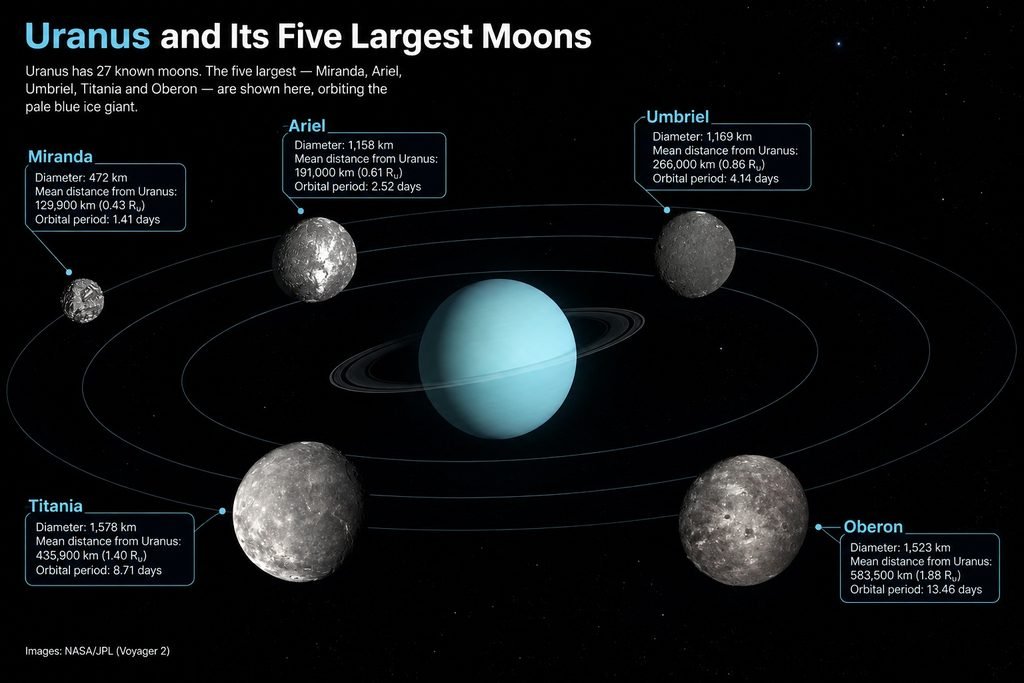
1. A Sideways System: How Many Moons of Uranus Are There?
To understand this system, we must first look at the bizarre orientation of the host planet itself. Unlike any other major planet in our solar system, this pale blue ice giant orbits the Sun completely rolled over on its side, boasting a staggering axial tilt of 97.77 degrees. Because the entire planetary system formed from the same primordial accretion disk, the natural satellites do not orbit along the standard flat ecliptic plane like they do around Earth or Jupiter. Instead, they orbit around the planet’s equator in a vertical, bullseye-like formation relative to the Sun.
This extreme sideways orientation creates incredibly bizarre seasonal cycles. During a solstice, one hemisphere of a moon will face the Sun continuously for 42 Earth years, plunging the other hemisphere into a freezing, uninterrupted, multi-decade-long night. Currently, astronomers have confirmed the existence of 28 distinct natural satellites orbiting the planet. These 28 celestial bodies are officially divided into three distinct astronomical groups: the thirteen inner ring moons, the five massive major moons, and the ten irregular outer moons. This diverse collection of frozen worlds ranges from tiny, dusty boulders shepherding the dark rings to massive icy spheres that may harbor deep, liquid water oceans beneath their frigid crusts.
2. A Shakespearean Tradition in the Sky
Before we dive into the geology of these fascinating ice worlds, it is essential to appreciate their highly unique naming convention. Throughout the solar system, the vast majority of planets and their natural satellites are traditionally named after prominent figures from Greek and Roman mythology. Jupiter’s satellites are named after the god’s lovers and descendants, while Saturn’s companions are named after the mythological Titans and Giants.
However, the seventh planet completely breaks this classical tradition. When William Herschel discovered the first two major companions in 1787, they were eventually named by his son, John Herschel, in 1852. Instead of turning to ancient mythology, John Herschel chose to honor classical English literature. Consequently, every single satellite in this system is named after characters from the iconic works of William Shakespeare and the famous poetry of Alexander Pope.
The two largest companions were named Titania and Oberon, the Queen and King of the Fairies from Shakespeare’s A Midsummer Night’s Dream. As more satellites were discovered over the centuries, the astronomical community strictly maintained this delightful literary tradition. Today, peering into this distant system feels like reading a dramatic, celestial play, featuring iconic characters such as Ariel, Umbriel, Miranda, Juliet, Puck, and Desdemona performing an eternal gravitational dance in the dark.
3. Miranda: The Frankenstein World and a Hidden Ocean
Of the five major satellites, the innermost and smallest is Miranda, measuring just 470 kilometers across. Despite its diminutive size, Miranda is arguably the most visually bizarre and scientifically baffling object in the outer solar system. When the Voyager 2 spacecraft flew past it in 1986, the images beamed back to Earth revealed a fractured, chaotic surface that looked like a mismatched jigsaw puzzle hastily glued together. Miranda features massive, jagged canyons up to 20 kilometers deep and unique, trapezoidal regions of heavily ridged terrain known as “coronae”.
For decades, scientists believed this tiny moon was a frozen, dead ball of solid ice. However, a groundbreaking study published in late 2024 completely revolutionized our understanding of Miranda. Researchers utilizing advanced computer models to match Miranda’s surface stress patterns made an incredibly surprising discovery: the geological features perfectly align with the presence of a vast, deep subsurface ocean of liquid water.
The 2024 study indicates that between 100 and 500 million years ago, intense tidal heating maintained an underground ocean that was at least 100 kilometers deep, hidden beneath a relatively thin icy crust of no more than 30 kilometers. Most astonishingly, astrophysicists now believe this massive interior ocean may not have entirely frozen solid yet, instantly elevating Miranda to a prime candidate for hosting potentially life-sustaining environments in the deep cosmos.
4. Ariel and Umbriel: The Active and the Ancient
Moving further out, we encounter Ariel and Umbriel, two mid-sized worlds that represent a striking geological dichotomy. Ariel, measuring roughly 1,160 kilometers in diameter, is the brightest and seemingly most geologically youthful of the major companions. Its surface is crisscrossed by a vast, interconnected network of deep tectonic canyons and rift valleys, many of which appear to have been flooded by ancient, viscous cryovolcanic lava (liquid water mixed with ammonia). Furthermore, recent astronomical research in 2023 strongly suggests that Ariel might still be actively releasing material, such as carbon dioxide vapor, into the surrounding space. This tantalizing evidence strongly implies that, much like Miranda, Ariel may currently harbor a warm, liquid ocean churning deep beneath its reflective icy crust.
In stark contrast, Umbriel is the darkest and most heavily cratered of the five major satellites. With a diameter of roughly 1,170 kilometers, it reflects very little sunlight and possesses an incredibly ancient surface that has remained geologically dead for billions of years. Its most prominent and mysterious feature is a bright, highly reflective ring of material located at the floor of the Wunda crater, which stands out brilliantly against the dark, ancient ice. Umbriel serves as a pristine, undisturbed time capsule, preserving the violent, chaotic impact history of the early solar system’s formation.
5. Titania and Oberon: The Giant Twins
The two outermost and largest members of this icy family are Titania and Oberon, both discovered by William Herschel in the late 18th century. Titania is the undisputed giant of the system, measuring 1,580 kilometers in diameter. Its surface is a fascinating mix of heavily cratered terrain intersected by an immense, global system of tectonic fault lines and deep trenches. The most prominent of these is the Messina Chasma, a massive canyon system that stretches for nearly 1,500 kilometers across the moon’s surface, dwarfing Earth’s Grand Canyon. Scientists believe that Titania once possessed a massive subsurface ocean that slowly froze over time; as the interior ice expanded, it violently fractured the outer crust, creating these massive global fault lines.
Oberon, orbiting at the furthest distance among the major moons of Uranus, is slightly smaller with a diameter of 1,520 kilometers. Because it orbits so far away from the intense tidal forces of the host planet, it lacks the dramatic tectonic features seen on Titania or Ariel. Oberon’s surface is ancient, dark, and saturated with massive impact craters. Fascinatingly, many of these craters feature mysterious dark material coating their floors, which astronomers suspect might be ancient, dirty cryovolcanic fluid that seeped out from the interior billions of years ago. Both of these giant twins possess a dense core of rock surrounded by a massive mantle of water ice.
6. The Inner Ring Shepherds and Puck
Orbiting intimately close to the pale blue ice giant, deep within its faint, dark ring system, is a fascinating collection of thirteen tiny inner satellites. These bodies were entirely unknown until the Voyager 2 spacecraft passed through the system in 1986. Because they orbit so close to the planet, their physical makeup is incredibly dark, absorbing almost all incoming sunlight and making them virtually invisible from Earth.
The most crucial role of these inner satellites is their gravitational interaction with the planetary rings. Moons like Cordelia and Ophelia act as “shepherd satellites” for the bright, narrow Epsilon ring. Their localized gravitational pull meticulously herds the billions of tiny ice and dust particles, preventing the rings from dispersing into the void of space. The largest of this inner group is Puck, measuring roughly 162 kilometers across. Unlike the other inner satellites, Puck is large enough to have a roughly spherical shape, and its dark, grayish surface is heavily battered by crater impacts. The entire inner system is so tightly packed and chaotic that astronomers predict their orbits are highly unstable, meaning these tiny moons will likely collide with each other in a few million years.
7. The Outer Irregular Swarm and S/2023 U 1
Far beyond the orderly, circular orbits of the major satellites lies a massive, chaotic region populated by the irregular outer companions. These tiny, dark bodies did not form naturally from the planet’s original primordial accretion disk. Instead, they are ancient, rogue asteroids and icy centaurs that wandered into the system billions of years ago and were permanently captured by the gas giant’s immense gravitational well. Most of these outer satellites orbit in a “retrograde” direction, moving in the exact opposite direction of the planet’s rotation.
This outer group is currently the subject of intense, ongoing astronomical research, and new discoveries are still being made today. In late 2023, utilizing the powerful Magellan telescopes in Chile, astronomers spotted a faint, moving speck of light in the distant darkness. Announced to the global public in February 2024, this tiny new body, provisionally named S/2023 U 1, is currently the newest known addition to the system. Measuring only 8 to 12 kilometers in diameter, S/2023 U 1 now holds the title of the absolute smallest known companion among the irregular moons of Uranus. Taking an agonizingly slow 680 days to complete a single, highly elliptical orbit, this tiny new discovery highlights how much we still have to learn about the dark, distant edges of our solar system.
8. The Future of Uranian Exploration
Because of the staggering distance of nearly three billion kilometers, humanity has only visited this sideways planetary system once in history. The brief, fleeting flyby of Voyager 2 in 1986 provided almost all of the high-resolution imagery and scientific data we possess today. Crucially, because of the planet’s extreme 98-degree tilt at the time of the encounter, Voyager 2 was only able to photograph the southern hemispheres of these moons, leaving their northern halves completely uncharted and shrouded in mystery to this day.
However, the recent, explosive revelations regarding subsurface oceans and potential habitability on Miranda and Ariel have completely shifted the scientific community’s focus. In the recent Planetary Science Decadal Survey, the National Academy of Sciences officially prioritized the development of a flagship Uranus Orbiter and Probe (UOP) mission for the 2030s. This proposed spacecraft would spend years orbiting the ice giant, utilizing modern radar and spectrometers to finally map the northern hemispheres, measure the thickness of the ice crusts, and definitively confirm the existence of deep, life-sustaining underground oceans. Until that spacecraft arrives, the moons of Uranus will remain one of the most enigmatic, bizarre, and tantalizingly unexplored frontiers in the entire cosmos.
Leave a Reply