Whenever I spend a clear, crisp night in the backyard with my trusty 4-inch refractor telescope, pointing it toward the sixth planet from the Sun is always a magical experience. Seeing those delicate, perfect rings suspended in the dark void of space never fails to send shivers down my spine. However, while Jupiter proudly displays its four bright Galilean companions in a neat little row, the environment around the ringed giant is much more elusive. Through my modest 4-inch scope, observing its natural satellites is incredibly difficult. The blinding glare of the magnificent rings completely overwhelms the faint light of these distant worlds, making them practically invisible and leaving the space around the planet looking empty and mysterious.
Yet, what our backyard telescopes struggle to resolve, humanity’s greatest robotic emissaries—specifically the legendary Cassini-Huygens mission—have revealed in breathtaking, high-definition detail. The complete system of Saturn’s moons is not just a barren collection of cratered rocks; it is a staggering, diverse family of over 146 known celestial bodies. In this deeply comprehensive astronomical guide, we will explore the mind-boggling diversity of this system, the thick orange smog and methane lakes of Titan, the erupting hydrothermal geysers of Enceladus, the bizarre two-toned walnut shape of Iapetus, and the fascinating tiny shepherd satellites that meticulously sculpt the majestic rings.
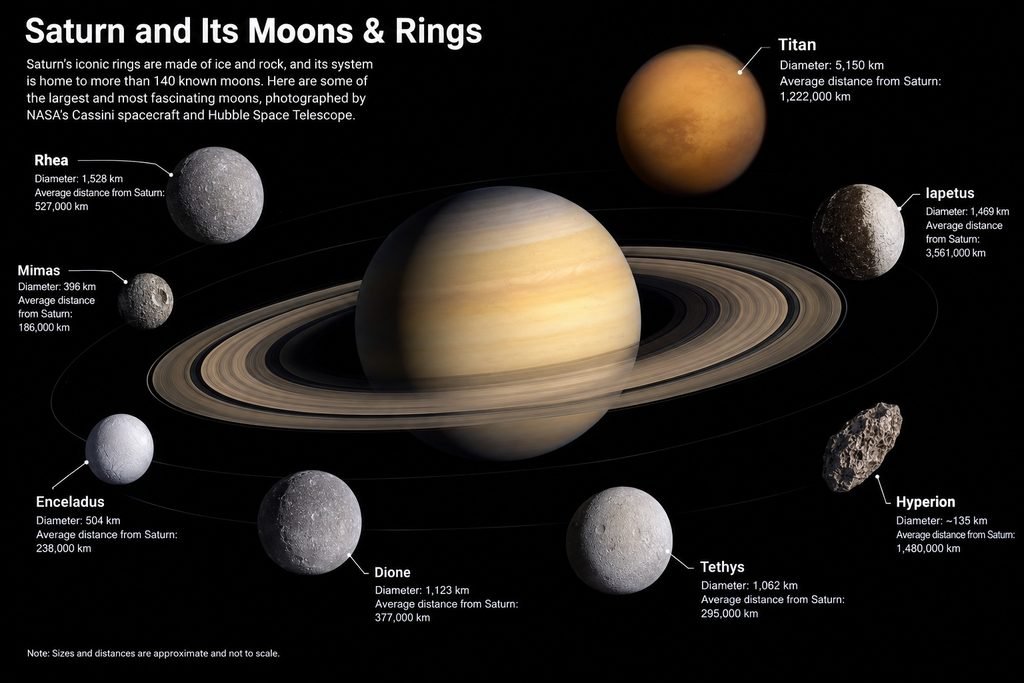
1. The Astonishing Diversity of Saturn’s Moons
For centuries, the area surrounding the ringed planet was a profound mystery. In 1655, utilizing an early, rudimentary telescope, the brilliant Dutch astronomer Christiaan Huygens discovered the first and largest of these companions, Titan. A few decades later, the Italian astronomer Giovanni Domenico Cassini discovered four more: Iapetus, Rhea, Dione, and Tethys. For a long time, astronomers believed these were the only companions circling the gas giant.
Today, thanks to advanced ground-based observatories and the 13-year orbital tour of NASA’s Cassini spacecraft, we know that this planet actually possesses the most extensive satellite system in the entire solar system. In 2023, the International Astronomical Union officially confirmed dozens of new, tiny, irregular satellites, pushing the total count past 146, officially dethroning Jupiter for the title of the “moon king” of the cosmos.
These celestial companions are incredibly diverse. They range from tiny, porous, irregular chunks of ice only a few kilometers across, to colossal, differentiated worlds larger than the planet Mercury. The vast majority of these satellites are primarily composed of water ice mixed with varying amounts of rocky material, making them true “ice worlds” born in the freezing depths of the outer solar system.
2. Titan: A Giant Shrouded in an Orange Haze
When discussing this majestic celestial family, one specific body absolutely dominates the conversation. Titan is not only the largest satellite in this particular system, but it is also the second-largest in the entire solar system (surpassed only by Jupiter’s Ganymede). Measuring 5,150 kilometers in diameter, it is significantly larger than Earth’s Moon and even larger than the major planet Mercury.
However, its sheer size is not its most fascinating attribute. Titan holds a completely unique distinction: it is the only moon in the solar system known to possess a dense, substantial atmosphere. In 1944, astronomer Gerard Kuiper utilized a spectrometer to discover that this thick, opaque atmosphere was rich in methane. Today, we know the atmosphere is remarkably Earth-like in its primary composition—it is composed of roughly 95% nitrogen, with the remaining 5% consisting of methane and trace amounts of complex organic molecules.
Because ultraviolet light from the Sun constantly breaks down the methane high in the atmosphere, it triggers complex chemical reactions that produce a thick, opaque, orange hydrocarbon smog (tholins). This dense smog completely hides the surface from optical telescopes on Earth. The atmospheric pressure at the surface is actually 50% greater than what we experience on Earth; if a human were to stand on Titan, they wouldn’t need a pressurized space suit, just an oxygen mask and extreme thermal protection against the freezing -180°C temperatures.
3. The Alien Hydrological Cycle: Titan’s Methane Lakes
Because the thick orange smog completely obscured the surface, scientists had absolutely no idea what lay beneath it until 2005. That year, the European Space Agency’s Huygens probe successfully detached from the Cassini orbiter, parachuted through the dense atmosphere, and became the first (and so far, only) human-made object to land in the outer solar system.
The data and images beamed back during the descent and from the surface were absolutely revolutionary. The surface of Titan is remarkably familiar, yet utterly alien. Because the temperature is a bitter -180°C, water ice acts like solid bedrock. However, Titan possesses a bizarre, active hydrological cycle. Instead of water, liquid methane and ethane evaporate into the orange sky, form clouds, and rain back down onto the icy surface.
This liquid methane carves deep river valleys and creates vast, dark seas and lakes near the polar regions. The Cassini spacecraft used specialized radar to map these massive bodies of liquid, naming the largest ones Kraken Mare, Ligeia Mare, and Punga Mare. Kraken Mare alone is larger than Earth’s Caspian Sea. Because Titan possesses abundant liquid solvents, organic molecules, and energy sources, astrobiologists consider it a prime laboratory for studying prebiotic chemistry and potentially discovering exotic, methane-based microbial life.
4. Enceladus: The Tiny World with a Global Subsurface Ocean
While Titan is the largest, the most scientifically tantalizing of Saturn’s moons is undoubtedly Enceladus. Measuring a mere 500 kilometers in diameter, this tiny, brilliant white sphere was long thought to be a dead, frozen block of ice. It has the highest albedo (reflectivity) of any body in the solar system, reflecting nearly 100% of the sunlight that hits it because its surface is covered in fresh, clean water ice.
In 2005, the Cassini spacecraft made a discovery that fundamentally changed the trajectory of planetary science. As Cassini flew past the southern pole of Enceladus, its cameras captured massive, spectacular geysers erupting from deep fractures in the ice known as “tiger stripes.” These powerful plumes were actively shooting water vapor, ice particles, and complex organic molecules hundreds of kilometers into space. In fact, these continuous eruptions are directly responsible for creating and sustaining the planet’s faint, expansive E Ring.
To analyze these plumes, NASA engineers daringly flew the Cassini spacecraft directly through the erupting geysers. The onboard mass spectrometers tasted the spray and detected salty liquid water laced with ammonia, methane, and complex carbon-based molecules. This conclusively proved that Enceladus harbors a massive, warm, global ocean of liquid saltwater beneath its icy crust, kept from freezing by intense tidal heating generated by its eccentric orbit. Furthermore, the detection of silica nanoparticles strongly suggests the presence of active hydrothermal vents at the ocean floor. With liquid water, a thermal energy source, and organic chemistry all present, Enceladus is currently considered the most likely place in the universe to find active, Earth-like alien biology.
5. Iapetus: The Two-Faced Walnut of the Outer System
Moving further out into the system, we encounter Iapetus, a world that is a masterclass in planetary weirdness. Discovered by Giovanni Cassini in 1671, Iapetus immediately presented a puzzle: Cassini could only see the moon when it was on the western side of the planet, but it completely vanished from his telescope when it moved to the eastern side.
Centuries later, robotic probes revealed exactly why. Iapetus is a starkly “two-toned” world, meaning one hemisphere is as bright as snow, while the other is as dark as charcoal. Because Iapetus is tidally locked (always keeping the same face toward the planet as it orbits), its leading hemisphere constantly sweeps up dark, reddish dust that spirals inward from a much more distant, retrograde satellite named Phoebe. This dark material absorbs sunlight and heats up the leading hemisphere, causing local water ice to sublimate (turn to gas) and migrate to the colder, trailing hemisphere, where it freezes again, permanently freezing this dramatic two-toned appearance in place.
As if its coloration wasn’t strange enough, Iapetus also possesses a bizarre equatorial ridge. A massive chain of mountains, reaching up to 20 kilometers high and 200 kilometers wide, runs perfectly along its equator, making the entire moon look exactly like a giant, cosmic walnut. The exact origin of this towering equatorial ridge remains one of the greatest unsolved mysteries in planetary geology.
6. Mimas and the Ring-Sculpting Shepherds
Among the smaller of Saturn’s moons, the “shepherds” play a profoundly crucial role in maintaining the architectural beauty of the entire system. Before we discuss the tiny shepherds, we must mention Mimas, a heavily cratered, icy rock roughly 400 kilometers in diameter. Mimas is famous for a single, colossal impact crater named Herschel, which covers nearly a third of the entire moon’s face. This massive crater gives Mimas a striking and undeniable resemblance to the “Death Star” from the Star Wars film franchise.
Deeper within the majestic rings themselves, we find the fascinating shepherd satellites, such as Pan, Daphnis, Prometheus, and Pandora. These are tiny, irregularly shaped chunks of ice that orbit intimately within the dense ring system. As they travel through the rings, their localized gravity pulls and pushes the billions of icy ring particles.
For example, the tiny moon Daphnis orbits inside a narrow gap in the A Ring called the Keeler Gap. As it moves, its gravity kicks up vertical waves of ice particles along the edges of the gap, creating mesmerizing, three-dimensional ripples in the otherwise perfectly flat rings. Similarly, Prometheus and Pandora orbit on either side of the thin, outer F Ring, using their combined gravitational influence to “herd” the ring particles, keeping the narrow F Ring tightly constrained and preventing it from dissipating into space.
7. The Outer Swarms: Norse, Gallic, and Inuit Groups
Beyond the massive, orderly orbits of Titan and Iapetus lies a vast, chaotic swarm of irregular satellites. Today, thanks to the deployment of massive, highly sensitive ground-based telescopes and advanced digital imaging techniques, astronomers have discovered dozens of these tiny outer satellites, pushing the total count of known Saturn’s moons to over 146.
Astronomers classify these irregular satellites into three distinct dynamic groups based on their orbital characteristics: the Norse, Gallic, and Inuit groups. The Norse group is the largest, consisting of dozens of tiny moons that orbit in a retrograde direction (opposite to the planet’s rotation). Phoebe is the largest and most famous member of this group, and as mentioned earlier, it is the primary source of the dark dust coating the leading hemisphere of Iapetus. The study of these irregular swarms provides astrophysicists with crucial data regarding the chaotic, violent migrations of planets during the very early days of solar system formation.
8. The Future of Exploration: The Dragonfly Rotorcraft
Because of the breathtaking discoveries made by the Cassini-Huygens mission, the study of Saturn’s moons continues to revolutionize our understanding of planetary science, oceanography, and astrobiology. The scientific community is incredibly eager to return to these distant ice worlds.
The next great leap in outer solar system exploration is already underway. NASA is actively developing the Dragonfly mission, an ambitious, nuclear-powered, dual-quadcopter rotorcraft designed specifically to explore Titan. Scheduled to launch in 2028 and arrive in the mid-2030s, Dragonfly will utilize Titan’s dense atmosphere and low gravity to literally fly from one location to another. It will explore diverse environments, from the organic sand dunes near the equator to an ancient impact crater where liquid water and complex organics once mixed.
As we point our terrestrial telescopes at that distant, ringed jewel in the night sky, we are no longer just looking at a beautiful planet. We are looking at a dynamic, active mini-solar system harboring underground oceans, methane rainstorms, and the tantalizing possibility that the fundamental ingredients for life may be flourishing in the dark, icy depths of the outer cosmos.
Leave a Reply