Understanding how a lunar eclipse occurs transforms the breathtaking experience of witnessing a dark, coppery-red moon into a profound cosmic lesson. A lunar eclipse, where the Moon is completely swallowed by Earth’s shadow, is one of the most spectacular astronomical events that allows people anywhere in the world to see the grand mechanisms of the universe operating right before their eyes.
With a spectacular eclipse happening in just a few days on August 28, 2026, this guide provides a detailed, universally easy-to-understand explanation of this celestial phenomenon—perfect for both curious minds and scientifically inclined adults. We’ve also prepared a comprehensive 10-year global schedule of major total lunar eclipses so you can apply your stargazing knowledge wherever you travel.
Tip 1: The Science of How a Lunar Eclipse Occurs
To truly grasp this incredible phenomenon, we must first visualize the cosmic dance of three celestial bodies: the Sun, Earth, and the Moon.
- A Perfect Cosmic Alignment: Our Earth orbits the massive, light-emitting Sun, while the Moon orbits our Earth. Most of the time, the Moon shines by reflecting sunlight. However, occasionally, the Sun, Earth, and Moon align in a perfectly straight line. During this alignment, Earth blocks the sunlight, casting a massive shadow out into space. When the Moon orbits directly into this shadow, it is eclipsed. This precise alignment is the core principle of these cosmic events.
- Umbra and Penumbra: Earth’s shadow is divided into two parts. The ‘Umbra’ is the dark inner core where sunlight is completely blocked, and the ‘Penumbra’ is the lighter outer part where sunlight is only partially blocked. A total eclipse happens when the Moon falls completely into the umbra.
- The Blood Moon Phenomenon: During a total eclipse, the Moon doesn’t go pitch black; instead, it glows a deep, coppery red. Learning the science behind Earth’s shadow also explains this beautiful trick of light. As sunlight passes through our atmosphere, shorter wavelengths (blue light) scatter into space. However, longer wavelengths (red and orange light) bend and refract around the edges of Earth, directly illuminating the Moon.
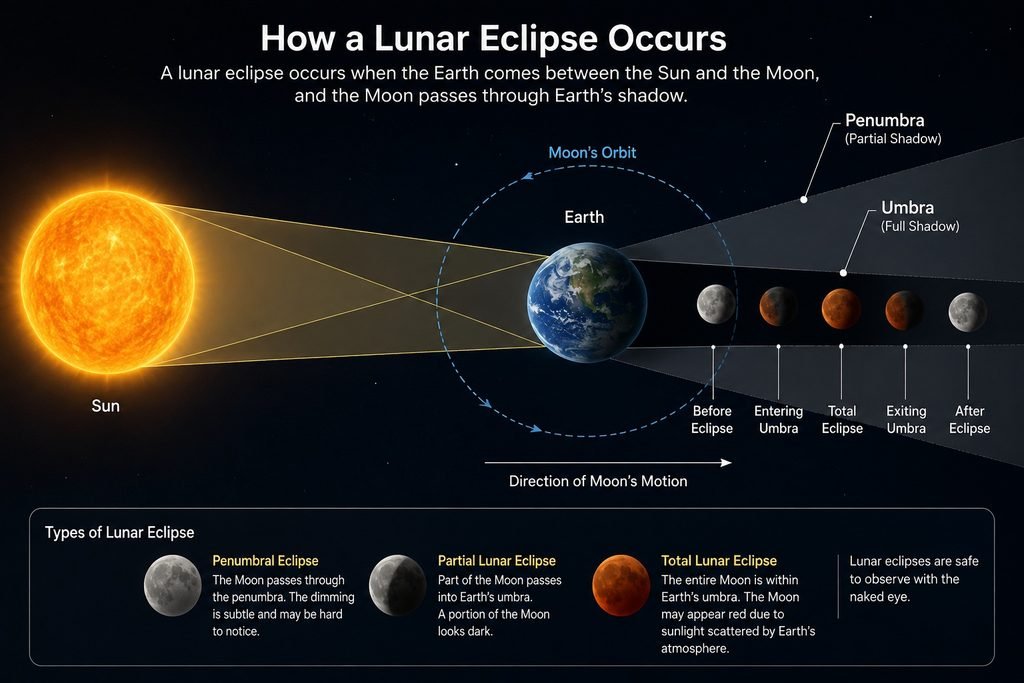
Tip 2: Prepare for the Next Big Event (August 28, 2026)
Now that you know the mechanics behind this event, it is time to witness one. A wonderful cosmic show is scheduled for August 28, 2026.
While it won’t be a 100% total eclipse, it is a very Deep Partial Lunar Eclipse, meaning over 93% of the Moon’s surface will plunge deep into Earth’s dark umbral shadow. This spectacular display will be optimally visible across North America, South America, Western Europe, and West Africa. If you are residing in or traveling through these regions, be sure to look up!
Tip 3: Plan Ahead with a 10-Year Global Schedule
The cosmic clock never stops. You can apply your knowledge of how a lunar eclipse occurs by planning viewing parties using this global schedule for the next decade:
- December 31, 2028: Visible in Asia, Europe, Africa, and Australia. A very special New Year’s Eve cosmic show to ring in 2029.
- June 26, 2029: Visible in Eastern North America, South America, Europe, and West Africa.
- December 20, 2029: Visible across the Eurasian and African landmasses.
- April 25 & October 18, 2032: Both events will be wonderfully visible across Asia, Australia, and Western parts of the Americas.
- April 14, 2033: Visible in Asia, Australia, East Africa, and parts of Europe.
Bonus Astronomy Trivia: 3 Space Facts for All Ages
While discovering the secrets of our solar system is fascinating, adding a few extra cosmic facts to your astronomy toolkit makes stargazing even more enjoyable:
- Sunsets on Mars are Blue: While sunsets on Earth are beautifully red and orange, watching the sun go down on Mars reveals a cool, bluish hue. The Martian atmosphere is thin and packed with fine red iron-oxide dust, which absorbs the red light but allows the blue light to pass straight through.
- The Moon is Slowly Drifting Away: The Moon looks the same size every night, but it is actually moving away from Earth at a rate of about 3.8 centimeters (1.5 inches) per year due to tidal friction.
- The “Spaghettification” of Black Holes: If an object fell into a black hole, the gravity pulling on the front part would be exponentially stronger than the gravity pulling on the back. The object would stretch out infinitely into a long, thin noodle shape. Astronomers worldwide use the official term “Spaghettification” to describe this.
Conclusion: The Joy of Understanding Cosmic Rhythms Knowing exactly how a lunar eclipse occurs turns a Blood Moon from a simple visual event into a profound milestone that reminds us of our place in the vast universe. We hope these astronomy tips have inspired you to look up at the night sky more often.
Leave a Reply