The cosmos offers many breathtaking spectacles, but few rival the awe-inspiring beauty of solar eclipses. Whether it is a partial or total eclipse, witnessing the moon obscure our nearest star is an unforgettable experience that connects us directly to the mechanical wonders of the universe. In this guide, we will explore the fascinating science behind these celestial events, share some personal observation experiences, and provide a comprehensive timeline for upcoming celestial events over the next decade.
1. The Science Behind Solar Eclipses
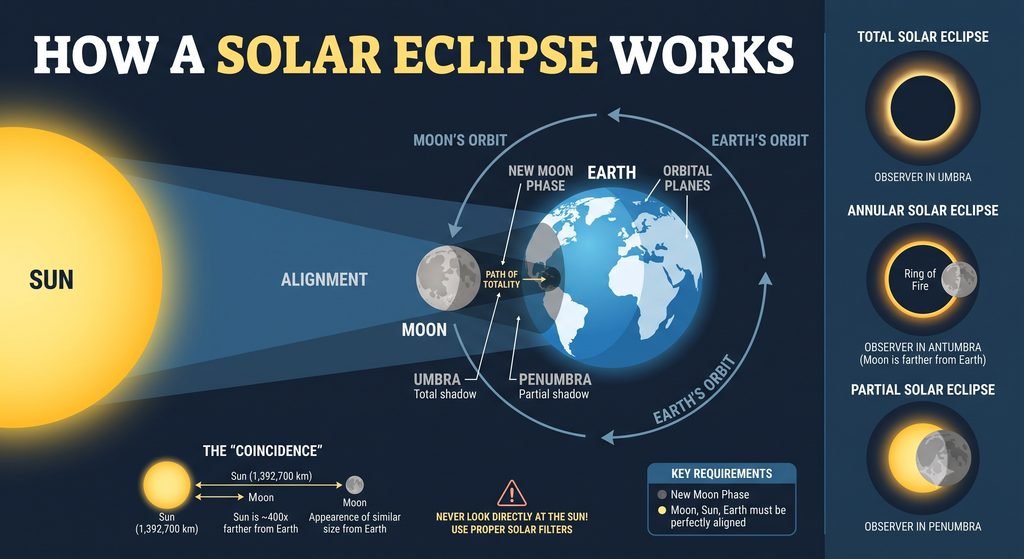
A solar eclipse occurs when the Moon passes directly between the Earth and the Sun, casting a massive shadow on our planet. However, not all eclipses look the same, and the view entirely depends on where you are standing within that shadow.
To help you understand the differences, here is a quick comparison:
| Type of Eclipse | How It Happens | What You See |
| Total Eclipse | The Moon perfectly aligns with the Sun, completely blocking its brilliant face. | A brief period of daytime darkness (totality) and the Sun’s glowing corona. |
| Annular Eclipse | The Moon is at its farthest point from Earth, making it appear smaller than the Sun. | A brilliant “ring of fire” surrounding the dark silhouette of the Moon. |
| Partial Eclipse | The Moon only partially obscures the Sun because the alignment is not perfect. | The Sun appears as if a glowing, crescent-shaped “bite” has been taken out of it. |
2. Capturing the Cosmos: My Personal Telescope Experience
Reading about the mechanics of solar eclipses is fascinating, but observing these phenomena firsthand elevates the experience entirely. The photographs featured in this article are from my own personal collection, captured on June 21, 2020, during a stunning partial solar eclipse.
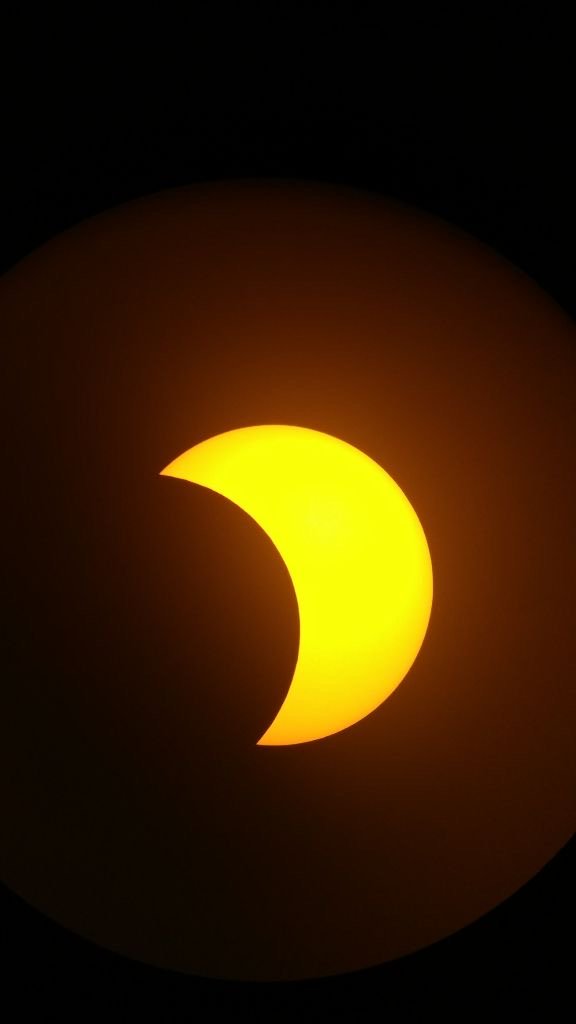
To capture these specific moments, I used my trusty Bresser Messier 4-inch refractor telescope. While it may not be the most massive or expensive observatory-grade equipment on the market, this classic 4-inch refractor provides beautifully crisp, high-contrast views of the solar system when paired with a proper, safe solar filter. Tracking the Moon as it slowly glided across the intensely bright solar disk through the eyepiece was a mesmerizing reminder of the precise clockwork of our universe. It proves that you do not need a multi-million-dollar facility to appreciate the wonders of astronomy.
3. Mark Your Calendars: Upcoming Solar Eclipses (2026–2036)
If you want to plan your own observation session and keep your eyes on the sky, here is a detailed list of notable upcoming total, annular, and partial eclipses over the next 10 years across the globe. Knowing these dates in advance is the best way to prepare for your next astronomical adventure:
- February 6, 2027 (Annular / Partial): An annular eclipse crossing South America (Chile, Argentina) and western Africa, visible as a partial eclipse in surrounding regions.
- August 2, 2027 (Total): A major total eclipse crossing Morocco, Spain, Algeria, Libya, Egypt, and Saudi Arabia.
- January 26, 2028 (Annular / Partial): Crossing northern South America, western Europe, and northern Africa.
- July 22, 2028 (Total): Visible primarily across the vast landscapes of Australia and New Zealand.
- 2029 (The Year of Partial Eclipses): 2029 is a unique year with no total or annular eclipses, but four separate partial eclipses (January, June, July, and December). The June 12 event will be widely visible across northern latitudes.
- June 1, 2030 (Annular / Partial): A major event visible across Europe, North Africa, and Asia. Many regions in Asia will experience a very distinct and deep partial eclipse.
- November 25, 2030 (Total): Crossing South Africa, the southern Indian Ocean, and Australia.
- May 21, 2031 (Annular / Partial): Visible across Africa, India, and Southeast Asia.
- November 3, 2032 (Partial): A significant partial eclipse visible across broad sections of Asia and Eastern Europe.
- March 20, 2034 (Total): Spanning across Central Africa and South Asia, including Nigeria, Chad, Egypt, Saudi Arabia, Iran, and China.
- September 2, 2035 (Total): A highly anticipated event. The path of totality crosses China, North Korea, and Japan. This will also be visible as a massive partial eclipse (over 90% obscured) across South Korea and other surrounding Asian regions.
A Quick Note on Safe Observation
Remember, you must never look directly at the Sun without certified solar viewing glasses, even during a partial eclipse. If you are using a telescope or binoculars, ensure you have a high-quality, securely fitted solar filter on the front objective lens.
For a complete, interactive catalog of celestial events, safety guidelines, and detailed trajectory maps for future solar eclipses, you can always visit the official NASA Eclipses Website.
Leave a Reply