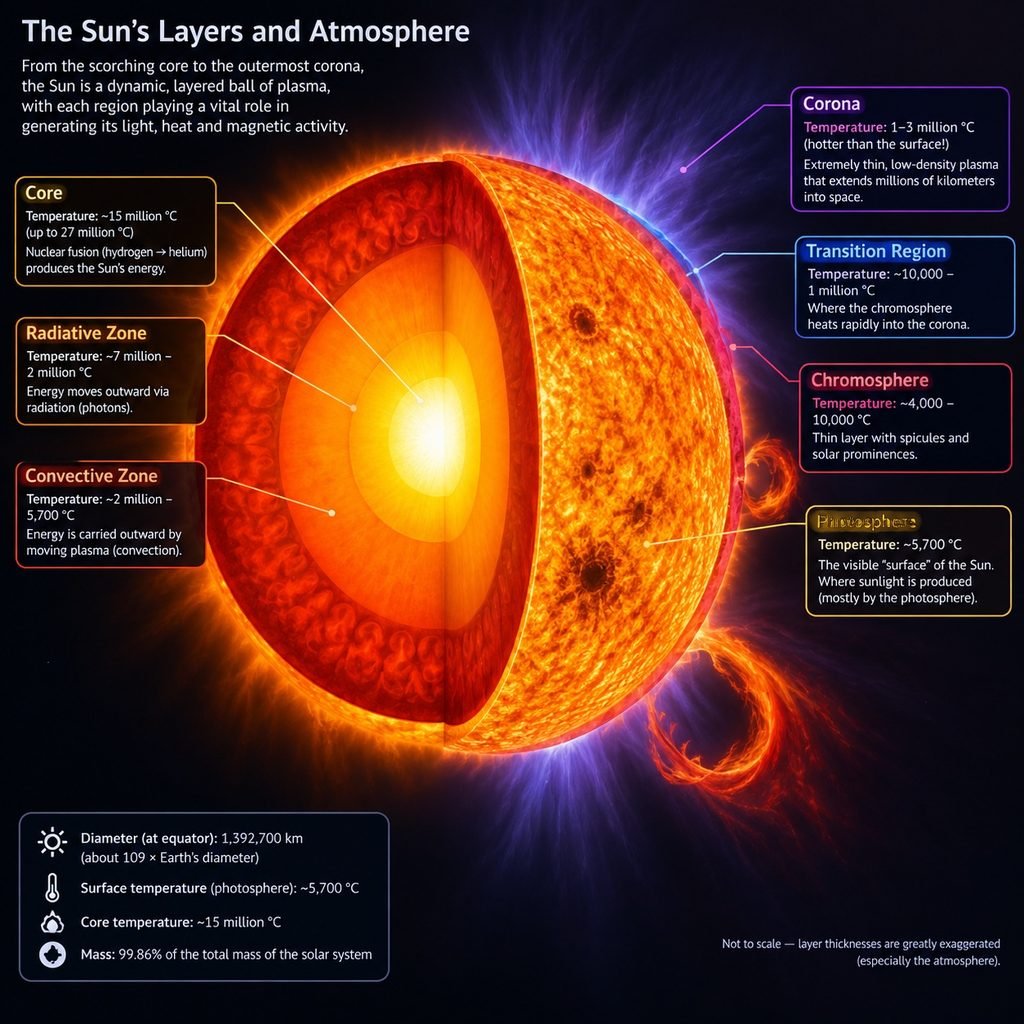
Every time I look up at the daytime sky (always using proper, safe solar filters, of course), I often marvel at the sheer, unimaginable scale of the star that powers our entire world. For millennia, humanity has worshipped it, tracked its movements to build calendars, and relied on its warmth to cultivate civilizations. At approximately 4.6 billion years old, our Sun has been constantly generating staggering amounts of energy through hydrogen nuclear fusion. Yet, incredibly, it is only about halfway through its expected main-sequence lifespan. It is truly mind-boggling to think about just how much hydrogen fuel must be packed inside to sustain such a massive, violent nuclear reaction for billions of years without ever running out.
In this comprehensive exploration, we will dive deep into the intricate internal mechanics of this stellar engine, trace the million-year journey of a single photon, examine the explosive dynamics of its atmospheric layers, discuss the terrifying historical impact of space weather, and look ahead billions of years to its ultimate, dramatic fate.
1. Core Specifications and the Sheer Scale of Our Sun
To truly appreciate why this giant mass of incandescent gas can burn for so incredibly long, we must first look at its mind-blowing physical numbers. This glowing sphere is the absolute gravitational anchor of our cosmic neighborhood. It accounts for an astounding 99.86% of all the mass in the entire solar system. This means that if you combined all the planets, moons, asteroids, and comets, they would barely make up a tiny fraction of a percent of the remaining mass.
Here are the detailed physical characteristics that define this majestic star:
| Feature | Specification Details |
| Equatorial Diameter | ~1.39 million km (109 times Earth’s diameter) |
| Volume | Roughly 1.3 million times the volume of Earth |
| Average Density | 1.41 g/cm³ (Confirming its entirely gaseous/plasma nature) |
| Equatorial Rotation | ~27 days (Differential rotation: ~35 days at the poles) |
| Energy Output to Earth | ~1.4 kW per square meter (Even at 150 million km away) |
| Core Temperature | ~15,000,000 K (Over 15 million degrees Celsius) |
| Surface Temp (Photosphere) | ~5,778 K (Roughly 5,500 degrees Celsius) |
Because of the extreme temperatures and the hundreds of billions of atmospheres of crushing pressure at the core, no solid or liquid matter can possibly exist anywhere inside. The entire celestial body is a massive, swirling ball of superheated plasma and electromagnetically charged gas. Furthermore, it does not rotate as a solid body. Its equator spins faster than its poles—a phenomenon known as differential rotation—which constantly twists and tangles its magnetic field lines, driving the violent solar activity we observe.
2. The Internal Structure: Nuclear Fusion in the Core
The interior of this stellar engine is divided into several distinct and highly specialized layers, each playing a crucial role in creating and transporting energy outward into the cold vacuum of space.
At the absolute center lies the Core. This is the beating heart of the star, occupying about 20% to 25% of its total radius. Here, the temperature reaches a staggering 15 million degrees Celsius, and the density is about 150 g/cm³—roughly ten times denser than solid lead. Under these extreme conditions, hydrogen atoms are stripped of their electrons, creating a soup of free-floating protons. Because protons are positively charged, they naturally repel each other with immense electromagnetic force.
However, thanks to the crushing pressure, extreme heat, and a bizarre quantum mechanics phenomenon known as “quantum tunneling,” these protons smash together and fuse into helium through a process called the proton-proton chain reaction. Every single second, the core converts approximately 600 million tons of hydrogen into helium. During this process, about 4 million tons of matter are completely annihilated and converted directly into pure energy, in the form of high-energy gamma rays and neutrinos, perfectly demonstrating Albert Einstein’s famous equation, E=mc².
3. The Long Journey: Radiative and Convective Zones
Once the energy is created in the core, it must make its way to the surface, but this journey is anything but quick.
Surrounding the core is the Radiative Zone, extending to about 70% of the star’s radius. In this zone, energy travels outward exclusively via thermal radiation. However, the plasma here is so incredibly dense that a newly born photon of light cannot travel in a straight line. It constantly crashes into other particles, being absorbed and re-emitted in random directions. Because of this chaotic “random walk,” a single photon can take anywhere from 100,000 to 1 million years just to zigzag its way through this single, opaque layer!
Above the Radiative Zone lies a very thin but vital boundary called the Tachocline. This interface layer is where the calm, uniform rotation of the radiative interior meets the turbulent, differential rotation of the outer layers. Modern astrophysics suggests that the intense fluid dynamics and sheer friction across this boundary are what power the solar dynamo, generating the star’s immensely powerful and complex magnetic field.
Finally, energy enters the Convection Zone, which stretches from a depth of 200,000 km up to the visible surface. Here, the temperature drops enough that the plasma becomes too opaque for radiation to pass through efficiently. Instead, heat is transported by physical motion, much like a violently boiling pot of thick soup. Huge bubbles of hot plasma rise to the surface, release their heat into space, cool down, and then sink back down to be reheated. This continuous boiling motion creates a turbulent, bubbling texture on the surface known as “granulation,” where each individual “bubble” is roughly the size of the state of Texas.
4. The Atmosphere, Sunspots, and the 11-Year Cycle
Above the boiling interior lies the atmosphere, which is completely transparent but equally complex and highly dynamic.
The visible surface that we see is called the Photosphere. It is not a solid crust, but rather a 100-kilometer-thick layer of gas emitting the visible light that illuminates our days. When looking at the solar disk, the center appears brighter than the edges, a visual phenomenon known as “limb darkening.”
Observable on the photosphere are Sunspots—dark, cooler regions caused by highly concentrated, twisting magnetic fields bursting through the surface. These magnetic fields inhibit the convection of heat from below, dropping the local temperature by thousands of degrees, which makes them appear pitch black against the surrounding glowing plasma. Sunspot activity is not random; it follows a highly predictable 11-year solar magnetic cycle. During the “Solar Maximum,” the surface is peppered with hundreds of sunspots, while during the “Solar Minimum,” the surface can remain completely blank for months at a time.
Above the photosphere lies the Chromosphere, an irregular layer stretching about 1,600 km high that glows a brilliant ruby-red during a total solar eclipse. Above this is a thin, mysterious Transition Region, where the temperature violently and inexplicably spikes from 20,000°C to over 1,000,000°C.
The outermost layer is the Corona, famous for its beautiful, pearly white streamers visible only when the Moon completely blocks the main disk. Due to its extreme, blistering heat, the corona brilliantly emits X-rays, allowing specialized satellites like the Parker Solar Probe to study its dynamic magnetic loops, coronal holes, and the origins of the solar wind.
5. Space Weather and the Threat of Solar Storms
When sunspots grow exceptionally large and their magnetic fields become too tangled, they can violently snap and reconnect. This releases pent-up magnetic energy in the form of Solar Flares—the largest explosions in the planetary system, emitting intense bursts of X-rays and ultraviolet light.
Often accompanying these flares are Coronal Mass Ejections (CMEs). A CME is a billion-ton cloud of superheated, highly charged plasma violently hurled into space at millions of kilometers per hour. If one of these massive clouds is directed toward Earth, it slams into our planet’s protective magnetosphere, triggering severe geomagnetic storms.
While this interaction creates breathtakingly beautiful auroras (the Northern and Southern Lights) that can sometimes be seen far from the poles, it also holds terrifying destructive potential. The most famous example is the Carrington Event of 1859, a massive solar storm that fried telegraph wires across the globe, literally shocking operators and setting paper ablaze. If a Carrington-class CME were to strike Earth today, the resulting electromagnetic surge could easily destroy modern satellite communications, disable global GPS navigation, and melt transformers in terrestrial power grids, potentially causing trillions of dollars in damage and plunging entire continents into darkness for months.
6. The Red Giant Phase and the Ultimate Fate of Our Sun
So, what is the ultimate destiny of this magnificent celestial body? In about 5 billion years, the hydrogen fuel in the core will finally be completely exhausted.
Without the outward pressure of hydrogen fusion to counteract the crushing weight of gravity, the core will rapidly contract and heat up drastically. This extreme heat will ignite a shell of hydrogen fusion outside the core, causing the outer gas layers to expand tremendously. This process will transform our Sun into a massive, swelling Red Giant. During this violent expansion phase, the star will grow so incredibly large that it will completely swallow the inner planets, definitely including Mercury and Venus.
As for Earth, its fate is tragically sealed. Even before the Red Giant phase peaks, the star’s gradually increasing luminosity will cause Earth’s oceans to boil away in about 1 billion years, stripping off the atmosphere and leaving behind a lifeless, scorched rock. As the star expands further, it will likely engulf Earth entirely.
Eventually, the core will become hot enough to briefly fuse helium into carbon. After this final, unstable fuel is spent, the dying star will gently puff its outer layers away into deep space, creating a beautifully glowing, expanding cloud of gas known as a planetary nebula. All that will remain at the dead center of our planetary system will be a white dwarf—a tiny, incredibly dense, Earth-sized core of carbon and oxygen that will slowly cool and fade into darkness over trillions of years.
7. Safely Observing the Star That Powers Us
Given the immense power of this stellar engine, observing it requires extreme caution. You should never, under any circumstances, look directly at it through a telescope or binoculars without certified, specialized solar filters securely attached to the front aperture. Doing so will cause instant, irreversible blindness.
However, with the right equipment, such as white-light filters or specialized Hydrogen-Alpha (H-alpha) telescopes, observing our local star is an incredibly rewarding experience for amateur astronomers. Through an H-alpha scope, the surface comes alive, allowing you to clearly see the dark sunspots, the textured granulation, and the magnificent solar prominences—massive loops of glowing plasma leaping off the edge of the star.
Knowing that the star above us operates through such incredibly complex physical layers, possesses the power to disrupt modern civilization, and holds such a dramatic, fiery final destiny, gives a deep sense of cosmic awe. This magnificent stellar engine will continue to light up the sky for billions of years, long after we have finished observing it.
Leave a Reply