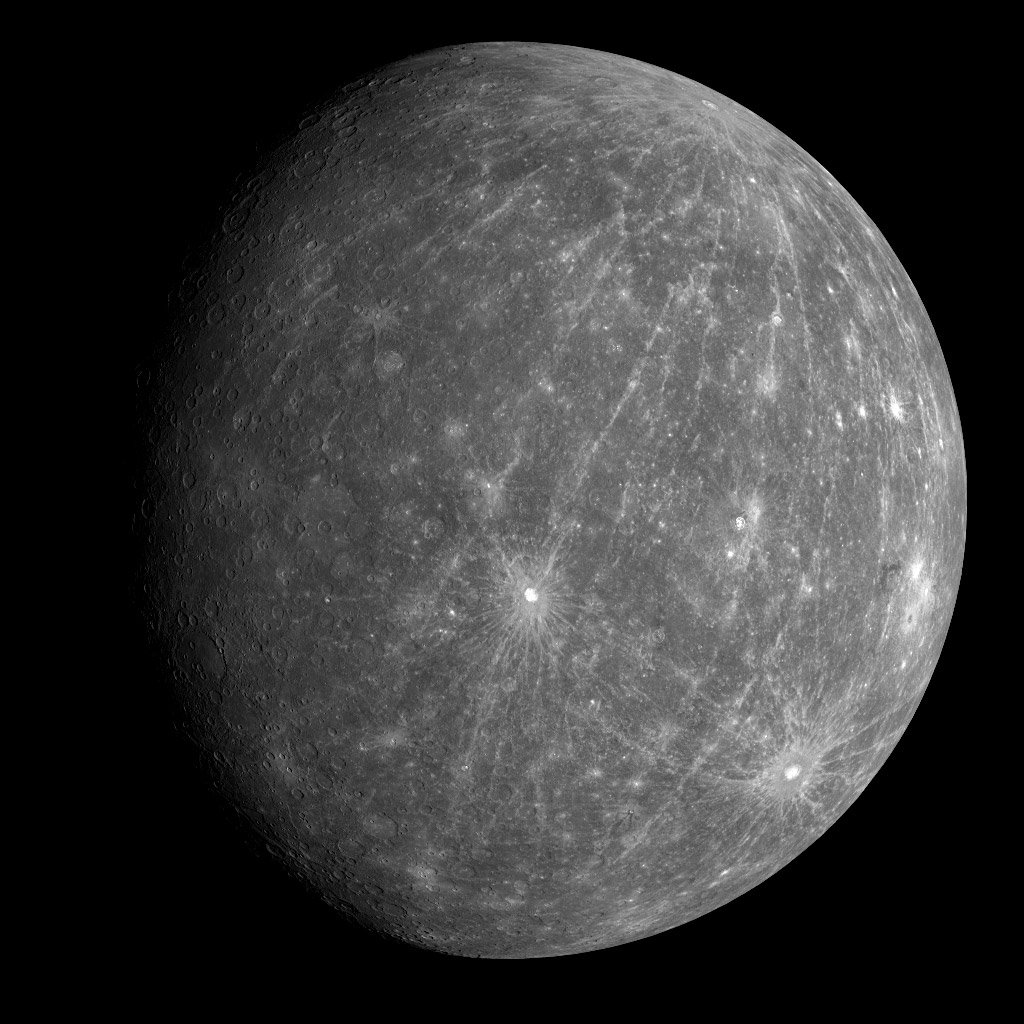
As the first rock from the Sun, planet Mercury is a world of fascinating, mind-bending extremes. Named by the ancient Romans after the swift-footed messenger of the gods due to its rapid movement across the sky, it orbits deep within the Sun’s intense gravitational well. At first glance through a telescope, its heavily cratered, grayish, and silent surface makes it look strikingly similar to our Moon. However, looking closer reveals a bizarre, incredibly dense, and highly dynamic world shaped by intense solar radiation, violent early cosmic collisions, and utterly unique orbital mechanics.
In this comprehensive exploration, we will delve deep into the detailed physical specifications, the extreme surface environment and shrinking crust, the astonishing scientific secrets hidden within its massive metallic core, the history of its exploration, and the notorious challenge of observing this small but mighty celestial body.
1. Core Specifications of Planet Mercury
To truly understand this extreme, sun-scorched world, we must first look at its fundamental physical numbers. Despite being the smallest planet in our cosmic neighborhood (its volume is only about 5.5% of Earth’s, making it barely larger than Earth’s Moon), it is incredibly heavy for its diminutive size.
Here are the detailed physical characteristics that define this innermost world:
| Feature | Specification Details |
| Equatorial Diameter | 4,879.4 km |
| Mass & Volume | 3.301 × 10²³ kg / 6.083 × 10¹⁰ km³ |
| Average Density | 5.427 g/cm³ (Second densest in the solar system) |
| Rotation Period | 58.646 Earth days |
| Surface Temperature | Ranging from 80 K (-193°C) to 700 K (427°C) |
| Atmospheric Pressure | ≲ 0.5 nPa (Extremely thin exosphere) |
| Surface Gravity | 3.7 m/s² |
While Earth is technically the densest planet in the solar system, this is primarily due to gravitational compression—Earth’s immense mass squeezes its core, increasing its density. If we were to factor out this gravitational compression, this small rocky world would actually be the densest planet in the solar system, hinting at an incredibly high concentration of heavy metals within its interior.
2. A Moon-like Surface, Shrinking Crust, and Extreme Temperatures
Studying planet Mercury reveals a surface severely battered by impact craters, much like our Moon. The most prominent geological feature is the Caloris Basin, a massive impact crater spanning 1,550 kilometers in diameter. The asteroid impact that created the Caloris Basin was so unimaginably violent that it sent massive seismic waves rippling straight through the planet’s core, causing the crust on the exact opposite side of the globe to buckle and fracture into a chaotic, jumbled region appropriately named the “Weird Terrain.”
Beyond the craters, the surface is crisscrossed by massive cliff-like structures known as lobate scarps, some of which stretch for hundreds of kilometers and rise up to 3 kilometers high. These scarps are actually enormous thrust faults. Because the planet possesses an unusually large iron core that is slowly cooling over billions of years, the entire celestial body is literally shrinking. As the volume decreases, the brittle rocky crust is forced to buckle and overlap, creating these massive wrinkles across the globe.
Because it lacks a substantial atmosphere to protect it from meteors or to distribute and trap heat, the temperature swings here are the most extreme in the entire planetary system. During the long day, the surface bakes at a scorching 427°C, hot enough to melt lead. But at night, without an atmosphere to retain the heat, it plummets to a freezing -193°C.
Its atmosphere is incredibly thin—technically classified as an exosphere—composed mainly of oxygen (42%), sodium (29%), hydrogen (22%), and helium (6%). These gases are constantly being stripped away by fierce solar winds and immediately replenished by vaporized micrometeorites and radioactive decay. Surprisingly, despite being so dangerously close to the Sun, radar observations in 1992 discovered massive deposits of water ice hidden deep inside permanently shadowed craters at the planet’s poles. Because the planet’s axis has almost zero tilt, the sunlight never reaches the bottoms of these deep polar craters, allowing ancient ice delivered by comet impacts to remain frozen indefinitely.
3. The Massive Iron Core and the Magnetic Mystery
Beneath the cratered, shrinking crust lies the true anomaly of this world. The internal structure is dominated by a monstrously massive iron core with a radius of about 1,800 kilometers. To put this into perspective, the core accounts for roughly 42% of the entire planet’s volume and a staggering 70% of its total mass. Surrounding this giant, dense metal heart is a surprisingly thin silicate mantle and crust, only about 600 kilometers thick combined.
Why is the core so disproportionately large? The leading hypothesis suggests that early in the solar system’s chaotic history, the planet was much larger and possessed a normal, thick rocky mantle. However, a catastrophic collision with another massive protoplanet stripped away most of the lighter, outer rocky material, leaving only the dense, metallic core behind to form the world we see today.
Furthermore, the Mariner 10 spacecraft detected a weak global magnetic field—about 100 times weaker than Earth’s. According to traditional dynamo theory, such a small, slow-rotating planet should have a completely solid core and, therefore, shouldn’t generate an active magnetic field. The discovery of this magnetic field baffled scientists for decades. Modern data from the MESSENGER spacecraft has revealed that a portion of the iron core remains molten and active, churning just enough to generate a weak but distinct magnetosphere that interacts dynamically with the intense solar wind.
4. The Bizarre Orbit of Planet Mercury and General Relativity
The orbital mechanics here are nothing short of mind-bending. For a long time, astronomers believed the planet was tidally locked to the Sun, keeping one side in perpetual daylight and the other in eternal darkness, just like our Moon is locked to Earth. However, radar observations in the 1960s proved that it is actually locked in a highly unusual 3:2 spin-orbit resonance. This means it rotates on its axis exactly three times for every two complete orbits around the Sun. Because of this bizarre synchronization, a single solar day (from sunrise to the next sunrise) lasts a staggering 176 Earth days!
This resonance, combined with a highly elliptical (eccentric) orbit, creates a visual phenomenon found nowhere else. If you were standing on the surface during perihelion (its closest approach to the Sun), the planet’s orbital speed would temporarily exceed its rotational speed. As a result, you would see the Sun rise, stop in the sky, move backward (retrograde) toward the horizon, stop again, and then resume its normal forward motion—a truly spectacular “double sunrise.”
Additionally, this highly eccentric orbit played a starring role in the history of modern physics. As its perihelion slowly shifts (precesses) over time, classical Newtonian physics could not explain a tiny orbital discrepancy of 43 arcseconds per century. In the 19th century, astronomers were so convinced Newton’s laws were absolute that they hypothesized the existence of a hidden planet named “Vulcan” orbiting between the Sun and Mercury, whose gravity was tugging on it. It wasn’t until 1915, when Albert Einstein applied his groundbreaking General Theory of Relativity—proving that the massive gravity of the Sun literally curves the fabric of spacetime around it—that this gravitational mystery was finally and elegantly solved, wiping Vulcan off the astronomical maps forever.
5. A History of Robotic Exploration
Because getting to this inner world requires an enormous amount of energy to decelerate against the Sun’s massive gravitational pull, it remains one of the least explored inner planets.
The first spacecraft to visit was NASA’s Mariner 10 in 1974. However, due to its orbital trajectory and the planet’s 3:2 resonance, Mariner 10 only saw the exact same sunlit hemisphere during each of its three flybys, leaving more than half the planet completely unmapped. It wasn’t until NASA’s MESSENGER probe successfully entered orbit in 2011 that humanity finally mapped 100% of the surface, analyzed the exosphere, and confirmed the existence of polar water ice. Today, the torch of exploration has been passed to the European and Japanese space agencies (ESA and JAXA) with their joint BepiColombo mission, which is designed to study the planet’s mysterious magnetic field and interior in unprecedented detail.
6. The Elusive Target: Observing Planet Mercury
Despite having an apparent magnitude that can peak around -2.4—making it theoretically brighter than Sirius, the brightest star in the night sky—observing this innermost world is notoriously and frustratingly difficult. Because its orbit is so tight, it never wanders far from the Sun from our perspective on Earth. It is almost always hopelessly lost in the Sun’s overwhelming, blinding glare.
Consequently, it can only be spotted for very brief, fleeting windows during twilight, right after sunset or just before sunrise. A total solar eclipse provides the absolute best viewing conditions, suddenly revealing the planet near the darkened Sun, but even then, it remains a tough target for the unprepared. In fact, due to these extreme difficulties and the requirement of a perfectly clear, unobstructed horizon, it is a famous astronomical legend that many renowned professional astronomers, including Nicolaus Copernicus himself, passed away without ever laying eyes on it!
The most practical way to spot it is during its greatest eastern elongation (looking at an unobstructed western horizon at dusk before it gets completely dark) or its greatest western elongation (looking east just before dawn). Given these extremely narrow viewing windows, low altitudes, and the interference of Earth’s atmospheric haze, I must admit that I have not yet managed to catch a clear glimpse of it through my own telescope. However, successfully tracking down this elusive, scorching, and fiercely dynamic world remains at the very top of my stargazing bucket list, waiting for that perfect, crisp twilight evening.
Leave a Reply