Understanding how our solar system operates is one of the most humbling, awe-inspiring, and profoundly fascinating experiences in the field of astronomy. When we look at the numbers, it might seem incredibly difficult to feel a personal connection to something so unimaginably vast, cold, and ancient. However, the simple act of observing the night sky through a telescope beautifully bridges that cosmic gap. Looking at a glowing planet through the eyepiece of a 4-inch refractor transforms abstract scientific facts into a tangible, breathtaking reality.
In this comprehensive guide, we will embark on a grand tour of our cosmic neighborhood. We will explore the delicate gravitational balance of the Sun, the distinctly unique characteristics of the eight major planets, the rocky remnants scattered in the asteroid belt, the intriguing history of Pluto’s classification, the active geology of various moons, and the grand orbital mechanics that keep everything perfectly synchronized.
1. The Heart of the Machine: Our Sun
To truly understand the dynamics of our solar system, we must begin at its absolute center. The Sun is a spectacular, middle-aged yellow dwarf star that single-handedly dominates our cosmic neighborhood. To put its sheer scale into perspective, the Sun accounts for a staggering 99.86% of the total mass in the entire planetary system. Every planet, moon, asteroid, and comet combined makes up just a tiny fraction of a percent of the remaining mass.
Deep within its core, the Sun acts as a colossal nuclear fusion reactor, crushing hydrogen atoms together to form helium under temperatures exceeding 15 million degrees Celsius. This violent, continuous reaction releases an incomprehensible amount of energy in the form of light and heat, which radiates outward across the vacuum of space, ultimately providing the warmth and energy required to sustain complex life on Earth. The Sun’s massive gravitational pull acts as the ultimate anchor, holding the entire planetary disk together and preventing these celestial bodies from drifting away into the cold, dark interstellar void.
2. The Inner Terrestrial Planets: Worlds of Rock and Metal
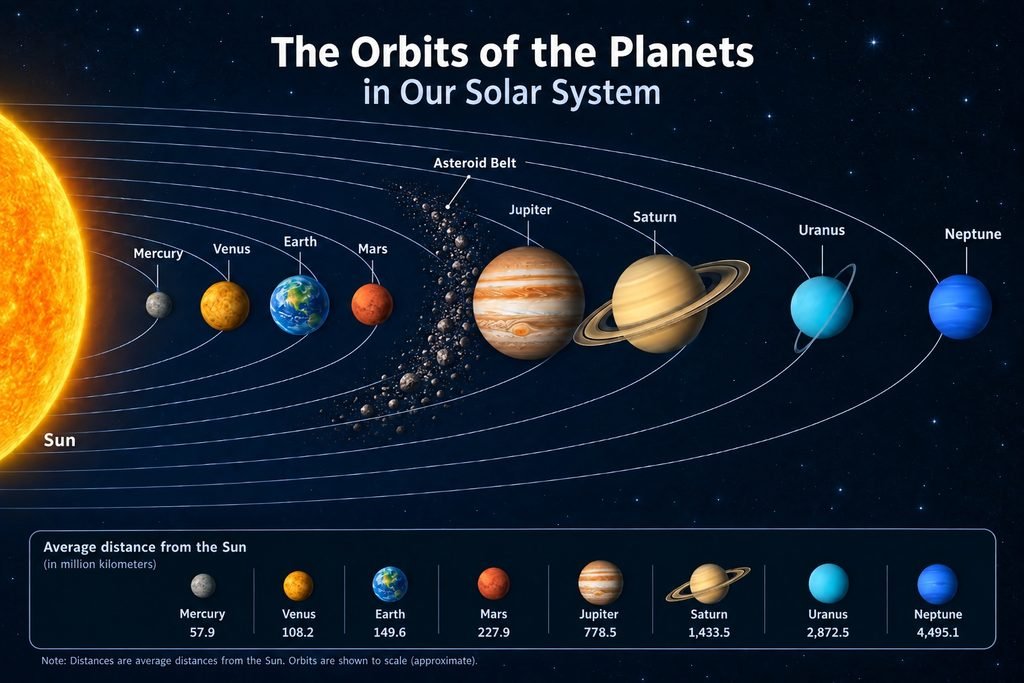
The cosmic neighborhood we call home consists of eight officially recognized planets, structurally divided into two main categories. The first group comprises the inner terrestrial planets: Mercury, Venus, Earth, and Mars. These are solid, rocky worlds with high densities, metallic cores, and relatively thin atmospheres, orbiting comfortably close to the Sun.
- Mercury: As the closest planet to the Sun, Mercury is a small, extreme, and heavily cratered world that closely resembles our Moon. Because it lacks a substantial atmosphere to trap heat, it experiences the most brutal temperature swings of any planet. During its long day, the surface bakes at 427°C, while at night, the temperature plummets to a freezing -193°C.
- Venus: Often referred to as Earth’s toxic twin, Venus is similar in size and mass but features a hellish environment. It is shrouded in a thick, crushing atmosphere composed mostly of carbon dioxide, resulting in a runaway greenhouse effect. With surface temperatures averaging 464°C—hot enough to melt lead—and a retrograde rotation that causes the Sun to rise in the west, Venus is a remarkably hostile world.
- Earth: Our vibrant, water-rich home is the largest of the terrestrial planets and the only known celestial body in the universe to harbor life. Nestled perfectly in the Goldilocks zone, Earth maintains liquid water on its surface. Its active plate tectonics, protective magnetic field, and breathable, oxygen-rich atmosphere make it a miraculous biological oasis in an otherwise barren expanse.
- Mars: With its distinct reddish hue caused by iron oxide (rust) on its surface, Mars remains a highly rewarding stargazing target for amateur astronomers. Although it is now a cold, desert world with a whisper-thin atmosphere, geological evidence suggests that ancient Mars once had rivers, lakes, and perhaps even a thick atmosphere, making it a primary target for humanity’s ongoing search for extraterrestrial life.
3. The Asteroid Belt: Leftovers of the Cosmos
Traveling outward past the orbit of Mars, we encounter a fascinating and chaotic region known as the asteroid belt. Orbiting primarily in the vast expanse between the rocky inner planets and the outer gas giants, this massive ring is filled with millions of irregularly shaped rocky fragments and metallic bodies.
These asteroids are the leftover building blocks from the early formation of the planetary system, roughly 4.6 billion years ago. Why did these rocks never coalesce into a full-fledged planet? The answer lies with Jupiter. The immense gravitational pull of the neighboring gas giant constantly disrupted this region, causing the rocky debris to crash into one another at high speeds rather than gently accreting into a single, large celestial body.
While science fiction movies often depict the asteroid belt as a densely packed minefield of flying rocks, the reality is quite different. The volume of space here is so incomprehensibly huge that the average distance between two large asteroids is millions of kilometers. While mostly composed of small, potato-shaped rubble, the belt also contains Ceres, a spherical rocky body large enough to be officially classified as a dwarf planet. Observing this region reminds us of the chaotic and violent origins of our planetary neighborhood.
4. The Outer Gas and Ice Giants of Our Solar System
Beyond the asteroid belt, the environment changes dramatically. Here, we find the massive outer giants: Jupiter, Saturn, Uranus, and Neptune. These colossal worlds dominate the outer regions of the planetary disk and lack solid surfaces, consisting primarily of deep layers of gas, liquid, and ice.
- Jupiter: The undisputed king of our solar system, Jupiter is a massive gas giant composed mostly of hydrogen and helium. It is more than twice as massive as all the other planets combined. Jupiter is famous for its complex, swirling weather systems and the Great Red Spot—a gigantic, raging anticyclonic storm that has been blowing for centuries.
- Saturn: Best known for its breathtakingly complex and beautiful ring system, Saturn is another gas giant that captivates anyone who observes it through a telescope. The rings are made of countless pieces of ice and rock, ranging in size from tiny dust grains to massive boulders. Amazingly, despite its immense size, Saturn has the lowest density of any planet; it is actually less dense than water.
- Uranus: Classified as an ice giant, Uranus contains heavier elements like oxygen, carbon, and nitrogen in the form of icy mantles beneath its atmosphere. Its most defining characteristic is its extreme axial tilt of 98 degrees. Uranus essentially orbits the Sun rolling on its side, likely the result of a catastrophic collision with an Earth-sized protoplanet early in its history.
- Neptune: Orbiting in the freezing, dark outskirts of the planetary system, Neptune is a dynamic and turbulent ice giant. Its vibrant blue color comes from methane in its atmosphere. Neptune boasts the fastest winds in the planetary system, reaching terrifying supersonic speeds of over 2,000 kilometers per hour.
5. The Kuiper Belt and the Historic Demotion of Pluto
For decades, students around the world learned that there were nine major planets. Pluto held the prestigious title of the ninth planet since its discovery in 1930. However, as telescope technology advanced in the late 20th and early 21st centuries, astronomers began discovering dozens of similar icy bodies in the distant outer reaches.
This region, a massive outer ring of primordial ice and rock located beyond the orbit of Neptune, is called the Kuiper Belt. In 2005, astronomers discovered Eris, a Kuiper Belt object that appeared to be even more massive than Pluto. This discovery sparked a massive scientific debate, forcing the International Astronomical Union (IAU) to officially redefine what it means to be a planet in 2006.
To qualify for major planetary status, a celestial body must meet three criteria: it must orbit the Sun, it must be massive enough for its own gravity to pull it into a spherical shape, and importantly, it must have “cleared its neighborhood” of other debris in its orbit. Because Pluto shares its orbital zone with thousands of other icy objects in the Kuiper Belt, it failed the third criterion and was dramatically reclassified as a “dwarf planet.” While it lost its major planet status, Pluto remains one of the most beloved and scientifically intriguing icy worlds we know, especially after the New Horizons probe revealed its stunning heart-shaped glacier in 2015.
6. Moons: The Active and Dynamic Worlds Beyond Planets
When exploring our solar system, we must not overlook the incredible diversity of its natural satellites. Almost every planet in this system, with the exception of Mercury and Venus, hosts its own moons. Earth has one, Mars has two tiny captured asteroids named Phobos and Deimos, and the massive giants possess dozens of intricate and highly active moons.
Witnessing this orbital mechanics firsthand is absolutely mesmerizing. When I manually align my 4-inch optics to observe Jupiter, spotting its four bright Galilean moons (Io, Europa, Ganymede, and Callisto) lined up perfectly is a powerful, undeniable visual reminder of gravity at work.
These moons are often more geologically active and scientifically fascinating than the planets they orbit. For instance, Jupiter’s moon Io is the most volcanically active body in the planetary system, constantly tearing itself apart due to intense tidal heating. Jupiter’s Europa and Saturn’s Enceladus hide vast, liquid water oceans beneath their icy crusts, making them prime targets in the search for extraterrestrial biological life. Meanwhile, Saturn’s massive moon Titan features a thick, hazy atmosphere and a surface covered with liquid methane rivers and lakes.
7. The Fringes: Comets and the Oort Cloud
The boundaries of our cosmic neighborhood extend far beyond the Kuiper Belt. Billions of kilometers away from the warming rays of the Sun lies the Oort Cloud, a theoretical, spherical shell of icy debris that surrounds the entire planetary system like a giant bubble.
This distant, frozen wasteland is believed to be the birthplace of long-period comets. Occasionally, gravitational nudges from passing stars or galactic tides will dislodge an icy chunk from the Oort Cloud, sending it on a long, spectacular journey toward the inner planets. As these “dirty snowballs” approach the Sun, the solar heat vaporizes their icy surfaces, creating the brilliant, glowing tails that have fascinated humanity for millennia.
8. The Grand Gravitational Dance of Our Solar System
The entire planetary structure is maintained by a grand, invisible cosmic dance. The Sun’s massive gravitational pull anchors everything in place—from the closest scorched rocky planet to the farthest icy comet in the Oort Cloud. Simultaneously, the planets’ immense forward momentum keeps them in stable, continuous orbits rather than being pulled directly into the star’s fiery surface.
The intricate mechanics of our solar system are truly a marvel of nature. The next time you look up at the night sky, remember that you are not just looking at random points of light. You are witnessing a perfectly balanced, billion-year-old clockwork of gravity, momentum, and planetary motion, offering an endless source of wonder and discovery for anyone willing to look up.
Leave a Reply