Whenever I set up my trusty 4-inch refractor telescope in the backyard on a crisp, clear night, pointing it toward the largest planet in our solar system is an absolute must. Through the eyepiece, the sight is always breathtaking: a massive, striped planetary disc flanked by four brilliant, tiny points of light perfectly aligned in a row. Seeing these four major Galilean companions with my own eyes always feels like peering into a beautifully active miniature solar system. However, my 4-inch telescope has its optical limits; I have never been able to spot the dozens of smaller, fainter satellites hidden deep within the planet’s brilliant, blinding glare.
Yet, what we cannot see through a modest backyard telescope, humanity has brilliantly explored through centuries of mathematics and decades of cutting-edge robotic spacecraft. The complete system of Jupiter’s moons is not just a collection of dead rocks; it is a highly dynamic, diverse, and chaotic family of over 90 known celestial bodies. In this incredibly comprehensive astronomical guide, we will explore the historic discovery that changed our worldview, the violent volcanic hellscape of Io, the astrobiological promise of Europa, the sheer scale of Ganymede, the ancient scars of Callisto, and the mysterious swarms of hidden satellites that remain forever out of reach of our terrestrial eyepieces.
1. The Historic Discovery of Jupiter’s Moons
The story of these magnificent celestial bodies is deeply intertwined with the greatest scientific revolution in human history. For thousands of years, the prevailing scientific and religious consensus was the geocentric model, which stated that Earth was the absolute center of the universe and that absolutely everything in the cosmos orbited around us.
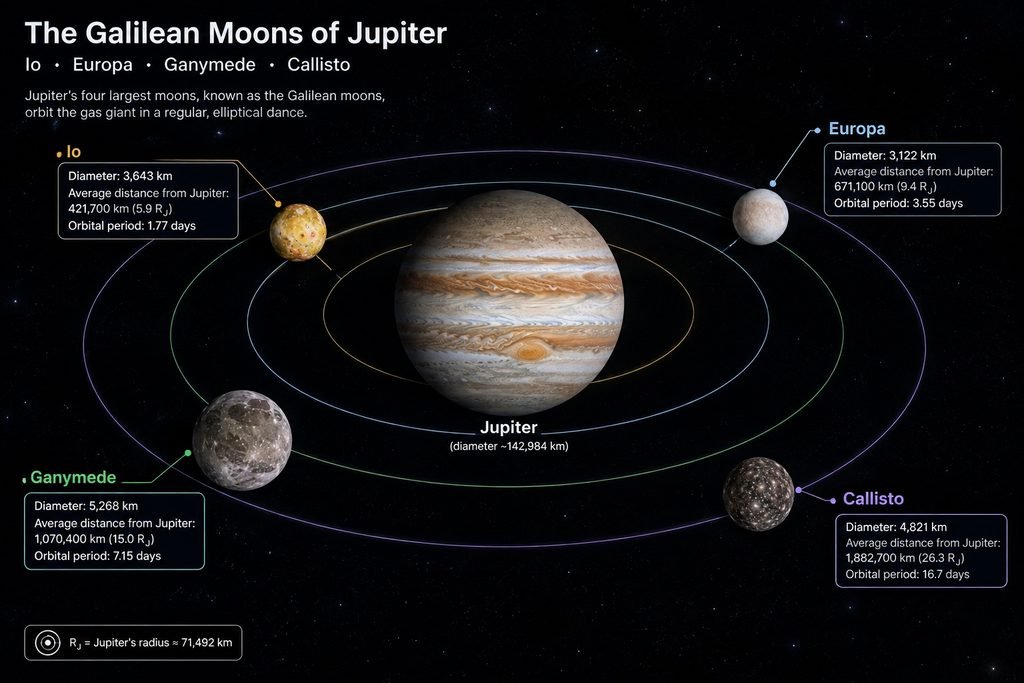
That fundamental belief was shattered in January 1610. Using a rudimentary, self-built refracting telescope that was far less powerful than a modern 4-inch amateur scope, Italian astronomer Galileo Galilei pointed his lens at the gas giant. Over several nights, he noticed three, and eventually four, distinct “stars” that were moving back and forth in a straight line around the planet. Galileo brilliantly deduced that these were not background stars, but natural satellites orbiting the giant planet.
This monumental discovery of the four largest Jovian satellites—later named Io, Europa, Ganymede, and Callisto by astronomer Simon Marius—provided the first conclusive, observational proof that not everything in the universe orbited Earth. This finding directly supported Nicolaus Copernicus’s heliocentric (Sun-centered) model, forever altering humanity’s understanding of our place in the cosmos.
2. Io: The Volcanic Hellscape of the Solar System
Moving from the innermost of the four major Galilean satellites outward, we first encounter Io. If you were looking for the most geologically active and violent place in the entire solar system, Io is the undisputed champion.
Despite being only slightly larger than Earth’s Moon, Io boasts over 400 active, erupting volcanoes on its surface. When the Voyager spacecraft flew past Io in 1979, scientists were absolutely stunned to capture photographs of massive volcanic plumes actively shooting sulfur and sulfur dioxide gas hundreds of kilometers into the freezing vacuum of space. The surface of Io is constantly being repaved by flowing lava, resulting in a distinct, pizza-like appearance covered in vivid shades of yellow, red, white, and black sulfur compounds.
But why is Io so violently active? The answer lies in its orbital mechanics. Io is caught in a relentless, agonizing gravitational tug-of-war. As it orbits, the massive gravitational pull of the host planet continuously stretches and squeezes the moon. Furthermore, the outer moons Europa and Ganymede routinely pass by and pull Io in the opposite direction. This continuous flexing creates immense internal friction—a process called tidal heating—which melts the interior of the moon into a subsurface ocean of boiling magma, continuously driving the apocalyptic volcanic eruptions on the surface.
3. Europa: The Icy Ocean World and the Search for Life
Moving one step further out, we find a world that is the stark opposite of the fiery Io. Europa is an icy, highly reflective, and seemingly serene sphere. It is slightly smaller than Earth’s Moon, but it currently stands as the single most promising location in the entire solar system to search for active, extraterrestrial life.
The surface of Europa is essentially a massive, global shell of water ice, crisscrossed by long, dark, brownish fractures and ridges known as lineae. There are very few impact craters on Europa, which indicates that its surface is incredibly young and geologically active, constantly shifting and erasing older craters. The true magic of Europa, however, lies beneath this frozen crust. Magnetic field data collected by NASA’s Galileo spacecraft provided overwhelming evidence that a massive, global ocean of liquid, salty water exists deep beneath the ice.
Astrophysicists estimate that Europa’s hidden subsurface ocean contains more than twice the amount of liquid water found in all of Earth’s oceans combined. Because Europa also experiences tidal heating (though less extreme than Io), the bottom of this deep ocean likely features active hydrothermal vents. On Earth, similar deep-sea hydrothermal vents support thriving ecosystems of exotic, alien-like creatures completely cut off from sunlight. Astrobiologists strongly suspect that if the ingredients for life—liquid water, organic chemistry, and a thermal energy source—exist together in Europa’s dark depths, it could very well harbor native microbial, or perhaps even complex, aquatic life.
4. Ganymede: The Magnetic Giant Among the Jovian Satellites
The third major Galilean satellite is Ganymede, a world defined by its absolute, sheer scale. With a diameter of 5,268 kilometers, Ganymede is the undisputed king of all satellites. It is the largest moon in the solar system, and it is actually significantly larger than the major planet Mercury and the dwarf planet Pluto. If Ganymede orbited the Sun directly instead of a gas giant, it would easily be classified as a major planet in its own right.
Ganymede is entirely unique among Jupiter’s moons and all other moons in the solar system for one incredible reason: it generates its own intrinsic global magnetic field. Deep within its interior, Ganymede possesses a churning, liquid iron core that functions as a planetary dynamo, much like Earth’s core. This magnetic field interacts dynamically with the host planet’s massive magnetosphere, creating brilliant, glowing auroras near Ganymede’s poles.
Structurally, Ganymede is highly differentiated. It consists of a metallic core, a rocky mantle, and a thick outer shell of water ice. Similar to Europa, scientific data strongly suggests that Ganymede also harbors a deep, subterranean ocean of liquid saltwater sandwiched between layers of thick ice. The surface itself is a fascinating patchwork of two distinct terrains: highly cratered, dark, ancient regions, and somewhat younger, brighter regions heavily scarred by massive tectonic grooves and ridges.
5. Callisto: The Ancient, Heavily Scarred Time Capsule
The outermost of the four major Galilean satellites is Callisto. Roughly the same size as the planet Mercury, Callisto is the complete opposite of the hyper-active Io and the dynamic Europa. Callisto is often described by planetary scientists as a “dead” world, but that lack of geological activity is exactly what makes it so incredibly valuable to science.
Callisto is the most heavily cratered object in the entire solar system. Its dark, icy surface is completely saturated with impact craters of every conceivable size, indicating that the surface has remained virtually unchanged for over 4 billion years. Because it orbits the furthest out of the four major moons, Callisto is not caught in the intricate orbital resonance that creates the intense tidal heating seen in Io, Europa, and Ganymede. Without that internal heat to drive geology, plate tectonics, or cryovolcanism, the craters from the brutal early days of the solar system’s formation were never erased.
Callisto serves as a pristine, frozen time capsule, preserving the violent history of the early cosmos. Its most famous feature is the Valhalla impact basin, a colossal, multi-ringed crater that stretches across thousands of kilometers, looking like a massive frozen ripple in a cosmic pond. Despite its dead appearance, induction measurements hint that Callisto might also hide a deeply buried, sluggish ocean of salty water beneath its ancient, battered crust.
6. The Hidden Inner Swarm of Jovian Moons
While my 4-inch refractor easily resolves the four massive Galilean worlds, the space immediately surrounding the gas giant is teeming with smaller bodies that are entirely invisible to amateur equipment. These are the inner moons: Metis, Adrastea, Amalthea, and Thebe.
Why can’t we see them through a 4-inch telescope? The answer involves their diminutive size, their incredibly dark composition, and their proximity to the planet. These moons are tiny, irregular, potato-shaped chunks of rock, with Amalthea being the largest at just about 250 kilometers across. Furthermore, they have an extremely low albedo (reflectivity), absorbing most of the sunlight that hits them. Orbiting incredibly close to the host planet, their faint, minuscule signatures are completely drowned out and washed away by the blinding, overwhelming glare of the giant planet in our eyepieces.
Despite their small size, these inner moons play a crucial dynamic role. Metis and Adrastea act as “shepherd moons.” They orbit intimately within the planet’s faint, dusty ring system. The continuous micrometeorite impacts on their surfaces kick up the fine dust that actually replenishes and sustains the host planet’s ethereal, ghostly rings, which would otherwise slowly spiral into the atmosphere and disappear.
7. The Irregular Outer Swarm: A Captive Audience
Beyond the ancient, cratered surface of Callisto lies a massive, chaotic expanse of space occupied by the irregular outer moons. Today, thanks to the deployment of massive, highly sensitive ground-based telescopes and advanced digital imaging techniques, astronomers have discovered dozens of these tiny outer satellites, pushing the total count of known Jupiter’s moons to over 90.
Unlike the Galilean moons and the inner swarm, which have relatively circular, stable orbits aligned with the planet’s equator, these outer irregular moons have wild, highly elliptical, and heavily inclined orbits. Fascinatingly, the vast majority of these outer satellites orbit in a “retrograde” direction, meaning they travel in the opposite direction of the planet’s rotation.
This retrograde motion is a massive astronomical clue. It conclusively proves that these tiny moons did not form naturally alongside the planet from a primordial disc of gas and dust. Instead, they are captured bodies. Billions of years ago, these were independent, rogue asteroids or icy comets from the deep outer solar system that wandered too close and were permanently ensnared by the gas giant’s immense gravitational trap.
8. The Future Exploration of Jupiter’s Moons
Because of their incredible diversity, their complex geological activity, and their profound astrobiological potential, this majestic celestial family remains one of the highest priorities for global space agencies. We are currently navigating a new golden era of exploration.
In April 2023, the European Space Agency successfully launched the Jupiter Icy Moons Explorer (JUICE) spacecraft, which will arrive in the early 2030s to conduct detailed studies of Ganymede, Callisto, and Europa. Even more excitingly, NASA successfully launched the heavily anticipated Europa Clipper mission in October 2024. This flagship robotic probe is currently speeding across the solar system, preparing to perform dozens of daring, low-altitude flybys through the deadly radiation belts to deeply analyze Europa’s icy shell and definitively determine if its subterranean ocean is capable of supporting life.
As we look up at the night sky through our modest backyard telescopes, admiring those four bright, aligned dots of light, we can take immense comfort in knowing that our robotic emissaries are currently speeding through the dark void. They are ready to finally unlock the profound, watery secrets hidden within these spectacular alien worlds, potentially answering the ultimate question of whether we are truly alone in the universe.
Leave a Reply