Stepping into the world of astronomy is a thrilling journey, especially when you have the right equipment. There is something profoundly magical about observing celestial bodies directly rather than just looking at pictures online. Over the years, the Bresser Messier AR-102 has been my trusted companion for exploring the night sky, transforming a casual interest into a deeply fascinating hobby.
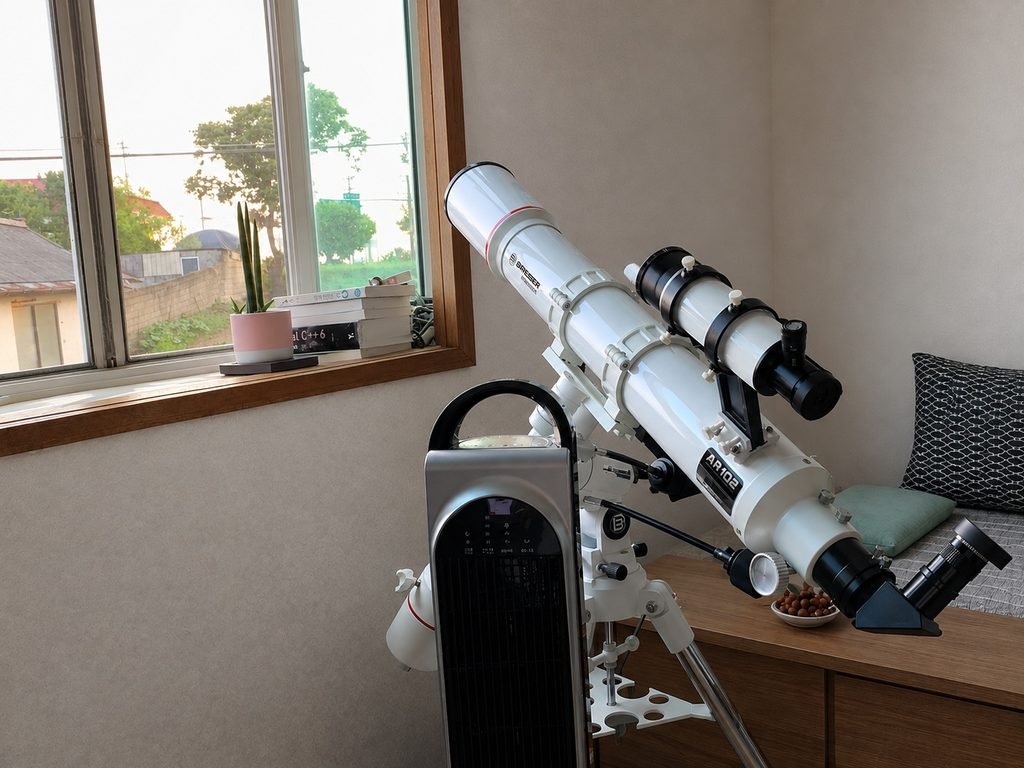
In this post, I want to share my personal experience using this fantastic 4-inch refractor, detailing its core specifications and the awe-inspiring moments it has given me—from manual planetary tracking to solar astrophotography.
1. Core Specs of the Bresser Messier AR-102
When it comes to delivering crisp, high-contrast images of the universe, the optical and mechanical build of a telescope is everything. This specific setup strikes a perfect balance between robust rigidity and user-friendly usability, especially for those who love the hands-on art of stargazing.
Here are the standout specifications that make this instrument so capable:
| Feature | Specification Details |
| Optical Design | Refractor telescope (Achromatic objective lens) |
| Aperture & Focal Length | 102mm lens diameter / 1000mm focal length (F/9.8) |
| Mount System | Stable Equatorial EXOS1/ST-2 Mount |
| Tracking Capability | Fine drive in both axes with slow-motion controls |
| Included Accessories | Solar filter, Smartphone adapter, 26mm Super Plössl eyepiece |
Operating the manual equatorial mount is a highly rewarding experience. Using the fine drive slow-motion controls in both axes allows for smooth, precise tracking of objects as they drift across the sky. It turns the process of finding stars into a truly engaging, tactile adventure.
2. Unforgettable Planetary Observations
Reading about the solar system is one thing, but witnessing it with your own eyes is an entirely different level of excitement.
I vividly remember pointing the Bresser Messier AR-102 toward Jupiter for the first time. Seeing the massive gas giant and spotting its four bright Galilean moons lined up like tiny diamonds was a truly magical experience. Saturn provided another breathtaking milestone. Viewing Saturn’s distinct rings directly through the eyepiece was surreal and genuinely fun. It is hard to describe the specific thrill of realizing that you have manually aligned your optics to look at a completely different world millions of miles away in real-time.
Alongside these gas giants, I have spent countless nights observing the distinct reddish hue of Mars and exploring the intricate, beautifully illuminated craters of our Moon.
3. Astrophotography and Solar Eclipses
This versatile instrument is not restricted to night viewing. Thanks to the included high-quality aperture solar filter, it doubles as a fantastic and safe tool for solar observation.
On June 21, 2020, I utilized this exact setup to observe a spectacular partial solar eclipse. Using the provided smartphone adapter, I successfully photographed the Moon taking a glowing “bite” out of the Sun. Capturing that astronomical event through my own optics was an incredibly rewarding achievement.
Whether you are marveling at planetary rings or capturing stunning solar transits, the Bresser Messier AR-102 offers the perfect combination of optical clarity and hands-on mechanical control for anyone passionate about the cosmos.
Leave a Reply