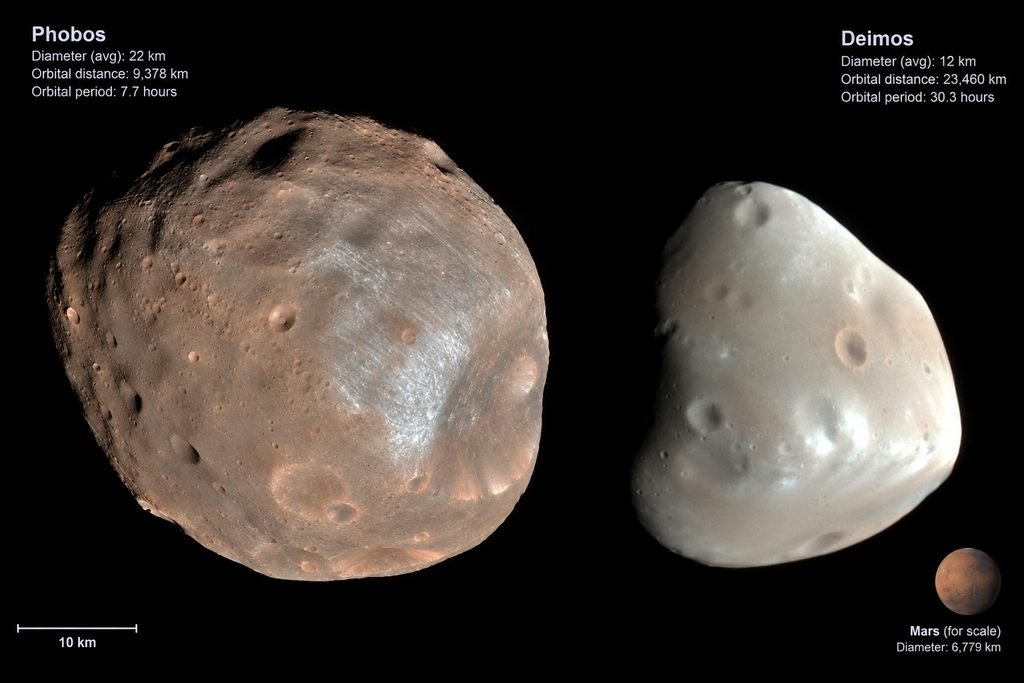
When amateur astronomers point their telescopes at the night sky, Earth’s massive, spherical Moon is usually the first and most breathtaking target. Our Moon dominates the sky, dictating our tides and stabilizing our planet’s axial tilt. However, when we cast our gaze outward to the next planet in the solar system, we find a completely different and utterly bizarre lunar relationship. The Red Planet is accompanied by two tiny, irregularly shaped chunks of rock that look more like battered potatoes than proper planetary satellites.
These two mysterious companions, Phobos and Deimos, represent one of the most fascinating orbital dynamics in the entire solar system. Unlike our stable Moon, these two tiny satellites are caught in a dramatic cosmic tug-of-war, with one doomed to be destroyed and the other slowly escaping into the void. In this highly comprehensive astronomical guide, we will explore the thrilling history of their discovery, the fierce scientific debate surrounding their origins, the terrifying fate that awaits the inner moon, and the groundbreaking robotic missions that will soon attempt to bring pieces of these alien rocks back to Earth.
1. The Historic Discovery of Phobos and Deimos
For centuries after the invention of the telescope, astronomers firmly believed that Mars was a solitary planet with no natural satellites. Johannes Kepler playfully hypothesized in the 17th century that since Earth had one moon and Jupiter had four (known at the time), Mars simply must have two to keep a mathematical progression. However, no one could actually find them.
The breakthrough finally came in August 1877, during a highly favorable “opposition” when Mars was exceptionally close to Earth. American astronomer Asaph Hall, working at the United States Naval Observatory in Washington, D.C., utilized a massive 26-inch refractor telescope—the largest in the world at the time—to hunt for Martian companions. The search was grueling. The glare from Mars was blinding, and the hypothetical moons were incredibly tiny and dark.
Frustrated by days of failure, Hall was on the verge of giving up the search entirely. It was his wife, Angelina Stickney Hall, who forcefully encouraged him to return to the observatory for one more night. Thanks to her relentless encouragement, Hall discovered the outer moon on August 12, 1877, and the inner moon six days later on August 18. This monumental discovery forever changed our understanding of the Martian system and cemented Hall’s legacy in astronomical history.
2. Mythological Namesakes: Fear and Dread
Following the tradition of naming celestial bodies after figures in classical mythology, Asaph Hall accepted a naming suggestion from Henry Madan, a Science Master at Eton College in England. Since Mars is named after the Roman god of war (the equivalent of the Greek god Ares), it was only fitting that his two companions be named after the mythological figures who accompanied him into battle.
In Greek mythology, Ares is accompanied by his twin sons. The inner moon was named Phobos, which translates to “Fear” or “Panic” (the root of the word phobia). The outer moon was named Deimos, which translates to “Terror” or “Dread.” These ominous, foreboding names perfectly suit the dark, battered, and chaotic nature of these two tiny, captured worlds orbiting the god of war.
3. Core Specifications of the Martian Moons
To truly understand how bizarre these satellites are, we must compare them to what we know about our own Moon. They are not massive enough for their own gravity to pull them into spheres; instead, they are “triaxial ellipsoids,” meaning they are lumpy, heavily cratered, and irregularly shaped.
Here are the detailed physical specifications of Phobos and Deimos:
| Feature | Phobos (Inner Moon) | Deimos (Outer Moon) |
| Dimensions | 27 x 22 x 18 km | 15 x 12 x 11 km |
| Mass | 1.06 × 10¹⁶ kg | 1.47 × 10¹⁵ kg |
| Average Distance from Mars | ~6,000 km from the surface | ~23,460 km from the surface |
| Orbital Period | 7 hours, 39 minutes | 30 hours, 18 minutes |
| Surface Gravity | 0.0057 m/s² (Extremely weak) | 0.003 m/s² (Barely noticeable) |
| Escape Velocity | 11 m/s (25 mph) | 5.6 m/s (12 mph) |
| Composition (Albedo) | Carbonaceous, dark (reflects 7% of light) | Carbonaceous, dark (reflects 7% of light) |
The surface gravity on these moons is so incredibly weak that a human astronaut standing on the surface could easily jump into orbit. If you were to throw a baseball with a decent amount of force, it would achieve escape velocity and fly off into deep space, never to return.
4. The Great Origin Debate: Captured Asteroids or Giant Impact?
Ever since their discovery, the origin of these two tiny companions has been a subject of intense, unresolved scientific debate. There are two primary competing hypotheses in the astrophysical community.
The first and most prominent theory is the “Captured Asteroid Hypothesis.” Spectroscopic analysis reveals that both moons are incredibly dark, reflecting very little sunlight. Their chemical composition appears highly similar to C-type (carbonaceous) and D-type asteroids found in the outer asteroid belt and Jupiter’s Trojan swarms. According to this theory, the moons were originally rogue asteroids that wandered too close to Mars and were permanently captured by its gravity. However, there is a massive problem with this theory: both moons have nearly perfect, circular orbits situated exactly on the Martian equator. If they were randomly captured asteroids, their orbits should be highly elliptical and randomly tilted. Circularizing a captured asteroid’s orbit requires immense atmospheric drag, which Mars’ thin atmosphere cannot easily provide.
The competing theory is the “Giant Impact Hypothesis,” similar to how Earth’s Moon formed. This theory suggests that billions of years ago, a large protoplanet violently smashed into Mars, blasting a massive ring of debris into orbit. Over time, this ring coalesced into several moons, most of which crashed back down to the surface, leaving only the two we see today. This elegantly explains their perfectly circular, equatorial orbits, but it fails to easily explain why their chemical composition looks like distant asteroids rather than Martian crust. Solving this origin mystery remains a top priority for planetary scientists today.
5. Phobos: The Doomed Inner Moon
The inner moon is a world of extremes, existing on the absolute brink of destruction. It orbits incredibly close to its host planet—just 6,000 kilometers above the Martian surface. To put that into perspective, Earth’s Moon orbits at a distance of roughly 384,000 kilometers. Because it is so close, Phobos orbits at a blistering speed. It completes a full orbit in just 7 hours and 39 minutes. This means it actually orbits faster than Mars rotates! If you were standing on the surface of Mars, you would witness a surreal sight: Phobos rising in the west, crossing the entire sky, and setting in the east, doing this two to three times every single day.
Visually, the most defining feature of this inner moon is the colossal Stickney Crater, named after Asaph Hall’s wife. This massive impact crater is 9 kilometers wide, taking up a significant portion of the moon’s entire surface. The impact that created Stickney was so violently energetic that it nearly shattered the entire moon to pieces. The surface is also covered in mysterious, long, shallow grooves. For years, scientists believed these were stress fractures from the Stickney impact, but recent computer models suggest they are actually tracks created by massive boulders rolling across the surface immediately following the impact.
Tragically, this inner moon is doomed. Because it orbits faster than Mars rotates, tidal forces are slowly decelerating its orbit, causing it to spiral inward toward the planet at a rate of roughly 1.8 meters every hundred years. In approximately 30 to 50 million years, it will cross the Roche limit. The immense gravitational tidal stress will literally tear the moon apart, transforming the battered potato into a spectacular, temporary rocky ring system around Mars, before the fragments eventually rain down on the Martian surface as a catastrophic meteor shower.
6. Deimos: The Escaping Outer Moon
In stark contrast to its doomed sibling, the outer moon, Deimos, faces a completely different orbital destiny. Orbiting much further away at a distance of 23,460 kilometers, it takes approximately 30 hours to complete a single revolution. Because its orbital period is slightly longer than the Martian day (which is 24 hours and 37 minutes), it exhibits a more traditional movement across the sky. From the surface of Mars, it rises in the east and sets in the west, but it moves agonizingly slowly. It takes roughly 2.7 days to cross the sky, during which it goes through its full cycle of phases twice.
Visually, Deimos is smaller and appears noticeably smoother than its inner sibling. While it is still heavily cratered, its craters are largely filled in with a thick layer of fine regolith (dust). Because the escape velocity on Deimos is a mere 5.6 meters per second, meteorite impacts kick dust up into orbit, which then very slowly falls back down, evenly blanketing the entire moon and softening its jagged features.
Just as tidal forces are pulling the inner moon toward destruction, these same tidal forces are pushing Deimos outward. Because it orbits slower than Mars rotates, the planet’s tidal bulge is constantly accelerating the moon, causing its orbit to gradually expand. Eventually, millions of years from now, Deimos will permanently escape the planet’s gravitational grip and drift off into the cold expanse of the solar system as a rogue asteroid.
7. Solar Transits: Eclipses on the Red Planet
One of the most fascinating phenomena involving Phobos and Deimos is their interaction with the Sun. Because they orbit so close to the Martian equator, they frequently pass directly between Mars and the Sun, creating solar eclipses. However, because both moons are so incredibly tiny, they are not large enough to completely cover the solar disk like Earth’s Moon does.
Instead of a total solar eclipse, Mars experiences what astronomers call “annular eclipses” or “solar transits.” When viewed from the surface, the moons appear as dark, jagged, potato-shaped silhouettes rapidly crossing the face of the Sun. Thanks to our robotic emissaries on the surface, including the Curiosity and Perseverance rovers, humanity has actually witnessed these transits in high-definition video. Watching a lumpy, misshapen rock swiftly glide across the glowing solar disk is a stark and beautiful reminder of how strange and alien the Martian environment truly is.
8. The Future of Exploration: The MMX Mission
Because of their incredibly weak gravity wells and their close proximity to the Martian surface, these two moons have long been viewed as the ultimate stepping stones for human exploration of the Red Planet. Astronauts could easily dock a spacecraft on their surfaces without needing massive amounts of fuel for a landing and subsequent liftoff. A base established here would offer perfect radiation shielding inside the craters and provide astronauts with real-time, zero-delay tele-robotics control of rovers on the Martian surface below.
Before humans arrive, however, the robotic exploration of Phobos and Deimos is about to take a massive leap forward. The Japan Aerospace Exploration Agency (JAXA) is currently preparing to launch the ambitious Martian Moons eXploration (MMX) mission. Scheduled to launch this year in October 2026, this groundbreaking spacecraft will insert itself into orbit around Mars, perform detailed remote sensing of both moons, and then execute a daring landing on Phobos.
The primary goal of the MMX mission is to collect pristine surface samples from the doomed inner moon and fly them safely back to Earth for rigorous laboratory analysis. By studying these physical samples, scientists finally hope to solve the ultimate mystery: are these moons captured ancient asteroids from the birth of the solar system, or are they the shattered, re-coalesced remnants of a violently impacted early Mars? Until those samples arrive, we will continue to gaze up at these two battered, potato-shaped companions, marveling at the cosmic dance of fear and dread unfolding around the god of war.
Leave a Reply