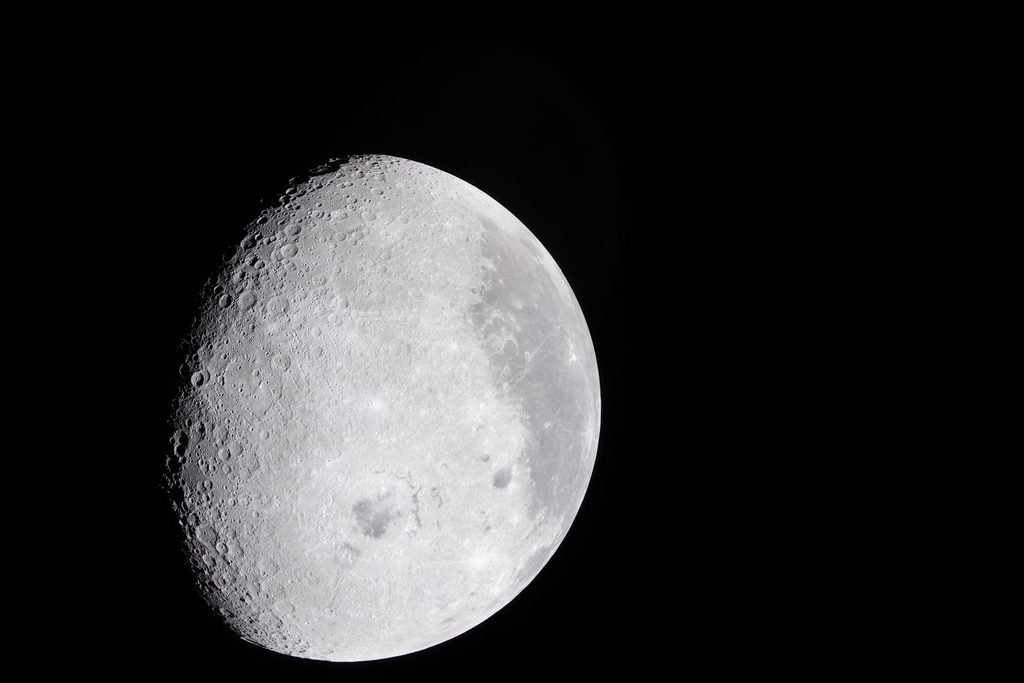
Since the dawn of humanity, when our ancestors first looked up at the night sky, one celestial object has consistently dominated our heavens, our mythology, and our scientific curiosity. I vividly recall the first time I pointed my 4-inch refractor telescope at this familiar celestial body. It was surprisingly bright—so intensely luminous that I had to quickly attach a lunar filter to my eyepiece just to view it comfortably. Once the blinding glare was reduced, I was absolutely mesmerized by the intricate details; seeing the countless, overlapping craters scattered across the rugged surface was a truly fascinating and unforgettable experience. As our closest cosmic neighbor, Earth’s Moon is a world of stark, silent beauty, preserving a pristine, four-billion-year-old record of the solar system’s violent history.
While it may appear as a simple, glowing orb in our night sky, this rocky satellite is actually an incredibly complex and dynamic geological world. It features towering highlands, vast plains of ancient lava, deep subterranean tunnels, and a bizarre, asymmetrical internal structure. In this incredibly comprehensive guide, we will explore the violent scientific theories surrounding its birth, its extreme surface environment, the mechanics behind eclipses and phases, and the groundbreaking 21st-century discoveries of lunar water and natural lava tubes that are currently paving the way for humanity’s permanent return to the lunar surface.
1. The Violent Birth: Four Theories of Formation
For centuries, astronomers hotly debated exactly how our planet acquired such a relatively massive satellite. The scientific community historically proposed four primary hypotheses to explain the origin of this celestial body.
- The Fission Model (Daughter Model): This early theory suggested that a rapidly spinning, molten early Earth spun so fast that a massive chunk of its outer crust and mantle literally flung off into space, forming the satellite. However, this model fails because the satellite’s orbital plane is aligned closer to the ecliptic (the Sun’s path) rather than Earth’s equator. Furthermore, it cannot explain why lunar rock compositions differ from terrestrial rocks in certain key aspects.
- The Co-creation Model (Sister Model): This hypothesis posited that both Earth and its satellite formed simultaneously side-by-side from the same primordial cloud of gas and dust. This model ultimately fails because it cannot explain why the satellite has a drastically different density and a much smaller iron core compared to Earth.
- The Captured Model: This theory suggested that the satellite formed in a completely different, distant part of the solar system and wandered aimlessly until it was permanently caught by Earth’s gravitational pull. While this perfectly explains the moons of Mars (Phobos and Deimos), it fails here. The satellite is simply too massive to have been smoothly captured by Earth’s gravity without a catastrophic collision, and isotopic analysis proves that Earth and its satellite share incredibly similar oxygen isotopes, indicating they formed in the exact same region of the solar system.
- The Collision Model (Giant Impact Hypothesis): Today, this is the overwhelmingly accepted scientific consensus. It proposes that roughly 4.5 billion years ago, a Mars-sized protoplanet named Theia violently collided with the early Earth. The catastrophic impact blasted massive amounts of Earth’s crust and Theia’s mantle into orbit, which eventually coalesced to form the satellite. This elegantly explains everything: the heavy iron core of Theia sank into Earth (explaining the satellite’s lack of iron), and the unimaginable heat of the collision vaporized all volatile elements (explaining the satellite’s dry, volatile-poor composition). Computer simulations have repeatedly proven the immense validity of this violent origin story.
2. A Tale of Two Landscapes on Earth’s Moon: Maria and Highlands
When you look at this celestial body through a telescope, or even with the naked eye, you immediately notice two distinct types of terrain. These contrasting geological features tell the story of a violently active past.
The dark, smooth regions are called the lunar “Maria” (Latin for “seas”). Covering about 35% of the surface, these areas are actually massive, ancient impact basins that were subsequently flooded by dark, basaltic lava billions of years ago. Because this lava paved over the older terrain, the Maria possess significantly fewer impact craters.
In stark contrast, the brighter regions are known as the Lunar Highlands. These areas are composed of anorthosite, a type of rock rich in calcium and aluminum plagioclase, which makes them highly reflective. The Highlands represent the original, ancient crust of the satellite and are saturated with countless overlapping craters from the Late Heavy Bombardment period. Because there is no atmosphere, wind, or flowing water to erode the surface, and no active plate tectonics to recycle the crust, every single meteorite impact from the past four billion years remains perfectly preserved.
3. The Danger and Promise of Lunar Regolith
The entire surface of this world is covered in a layer of fine, abrasive dust and broken rock known as regolith. Because there is no atmosphere to burn up incoming micrometeorites, they constantly rain down on the surface at hypersonic speeds, violently pulverizing the bedrock into a fine powder over billions of years. This regolith layer ranges in thickness from a few centimeters to tens of meters.
During the Apollo missions, this microscopic dust proved to be a massive hazard. The particles are incredibly jagged and sharp (because there is no wind or water to smooth their edges), easily penetrating spacesuit joints, scratching visors, and causing mechanical failures. However, this troublesome dust is also humanity’s greatest hope for lunar colonization. Chemical analysis reveals that lunar regolith is composed of roughly 50% oxygen by weight. Future astronauts plan to use advanced thermal and chemical extraction methods to harvest this oxygen for breathable air and rocket propellant, while using the remaining slag as a raw 3D-printing material to construct permanent lunar bases.
4. The Extreme Environment: Atmosphere and Temperature
Because Earth’s Moon is relatively small and possesses weak surface gravity (only one-sixth of Earth’s), it cannot hold onto a substantial atmosphere. What minuscule amounts of gas that do slowly seep out from its interior are quickly and violently blown away into deep space by the relentless solar wind.
Consequently, it exists in a hard vacuum. Without an insulating atmospheric blanket to trap and distribute heat, the surface experiences the most brutal and extreme temperature swings imaginable. During the two-week-long lunar day, the unfiltered sunlight bakes the surface to a scorching 400 Kelvin (127°C). However, the moment the Sun sets and the two-week-long lunar night begins, the temperature immediately plummets to a freezing 100 Kelvin (-173°C). Surviving these extreme, rapid thermal fluctuations is one of the greatest engineering challenges for designing lunar rovers and human habitats.
5. Internal Anatomy and the Thinner Near-Side Crust
Thanks to seismometers left behind by the Apollo astronauts, scientists have been able to map the internal structure of this world by measuring “moonquakes.” The vast majority of these deep tremors are not caused by tectonic plate movement, but rather by immense tidal forces generated by Earth’s gravitational pull.
Seismic data reveals a complex, differentiated interior consisting of a rigid crust, a solid lithosphere, a partially molten asthenosphere, and a surprisingly small iron core. One of the most fascinating discoveries is the extreme asymmetry of the crust. The crust on the near side (facing Earth) is significantly thinner than the crust on the far side. Astronomers believe that while the interior was still molten, Earth’s immense tidal gravity slowly pulled the heavier, denser materials toward the near side. Because the near-side crust is thinner, massive meteorite impacts were able to easily puncture it, allowing magma to bleed out and form the dark Maria. This perfectly explains why the far side of the satellite is almost entirely composed of bright, heavily cratered highlands with virtually no dark Maria.
Furthermore, unlike Earth, this world does not currently possess a global magnetic field. Because of its small size, its internal core cooled much faster than Earth’s, stopping the internal dynamo effect. However, localized patches of highly magnetized rock on the surface strongly suggest that it did possess a powerful global magnetic field billions of years ago.
6. Orbital Mechanics: Tidal Locking, Eclipses, and Phases
The orbital mechanics of this celestial body are mathematically beautiful. It orbits Earth every 27.3 days, and fascinatingly, it also takes exactly 27.3 days to rotate once on its own axis. This phenomenon is known as synchronous rotation or “tidal locking.” Because its rotational period perfectly matches its orbital period, it constantly shows the exact same face to Earth. Humanity had absolutely no idea what the “far side” looked like until October 1959, when the Soviet Luna 3 spacecraft finally flew behind it and snapped the first historic photographs.
As this world orbits Earth, our changing perspective of the Sun’s illumination creates the beautifully predictable lunar phases. A complete cycle of phases (a synodic month) takes about 29.5 days. The primary phases are mathematically predictable:
- New Moon (Day 0): The satellite is between Earth and the Sun; the illuminated side faces away from us.
- First Quarter (Day 7): The satellite has traveled 90 degrees; we see exactly half of the Earth-facing side illuminated.
- Full Moon (Day 14): The satellite is at 180 degrees, opposite the Sun; the entire Earth-facing side is brilliantly illuminated.
- Third Quarter (Day 21): The satellite is at 270 degrees; the opposite half is illuminated before returning to the New Moon.
This precise orbital dance also creates eclipses. By an incredible cosmic coincidence, the Sun is roughly 400 times larger in diameter than the satellite, but it is also roughly 400 times farther away. This makes them appear to be the exact same size in our sky. When the orbital plane aligns perfectly, a Solar Eclipse occurs when the satellite passes directly in front of the Sun, casting a shadow on Earth. Conversely, a Lunar Eclipse occurs when the satellite passes completely into Earth’s shadow, turning the surface a deep, blood-red color.
7. The 2009 Water Discoveries and Lunar Lava Tubes
For decades, scientists believed the surface of Earth’s Moon was bone dry. However, the year 2009 completely revolutionized our understanding of lunar hydrology. A fleet of international spacecraft, including India’s Chandrayaan-1, NASA’s Deep Impact, and the Cassini probe, detected conclusive spectroscopic evidence of water molecules and hydroxyl groups widely distributed across the sunlit surface. These molecules are likely created when hydrogen protons from the solar wind slam into oxygen-rich minerals in the regolith.
The climax of this watery revelation came on October 9, 2009, when NASA intentionally crashed the LCROSS probe into the permanently shadowed Cabeus crater near the south pole. The resulting explosive plume was analyzed and proved the existence of massive, pristine deposits of water ice hidden in the freezing darkness.
Just weeks later, on October 24, 2009, the Japanese space agency (JAXA) made another monumental announcement. Analyzing data from their Kaguya orbiter, they discovered a massive, vertical hole in the Marius Hills region of the Oceanus Procellarum (Ocean of Storms). This incredible sinkhole is roughly 70 meters wide and 90 meters deep, leading directly into a massive, intact underground lava tube that stretches for hundreds of meters. JAXA and global space agencies immediately recognized the immense value of this discovery. These massive underground tunnels offer ready-made, natural bases for future human astronauts, perfectly shielding them from the deadly solar radiation, extreme temperature fluctuations, and relentless micrometeorite impacts on the surface.
As NASA’s Artemis program prepares to return humans to the lunar surface, these profound discoveries of water ice and subterranean lava tubes have transformed our silent, glowing neighbor from a barren rock into the ultimate stepping stone for humanity’s expansion into the deeper cosmos.
Leave a Reply