Whenever amateur astronomers set up their equipment under a dark, star-filled sky, the outer limits of the solar system constantly beckon to our collective imagination. While my trusty 4-inch refractor telescope has provided me with breathtaking, unforgettable views of Jupiter’s swirling bands and Saturn’s delicate rings, the freezing, mysterious objects residing in the pitch-black void beyond Neptune remain far beyond the reach of standard optical observation. However, what we lack in visual accessibility from our backyards, humanity has more than made up for with sheer mathematical ingenuity, relentless curiosity, and groundbreaking robotic exploration.
For decades, one tiny, icy world held the prestigious and beloved title of the ninth planet in our solar system. Today, dwarf planet Pluto remains one of the most famous, scientifically intriguing, and culturally significant celestial bodies we have ever discovered. In this incredibly comprehensive guide, we will explore the thrilling history of its discovery, the massive icy expanse known as the Kuiper Belt, the dramatic scientific debate that led to its historic demotion, the breathtaking geological revelations of the New Horizons mission, and the complex, chaotic moon system that orbits it.
1. The Search for Planet X and a Historic Discovery
The story of this distant icy world begins long before it was actually seen through a telescope. In the late 19th and early 20th centuries, astronomers meticulously tracked the orbits of Uranus and Neptune. They noticed minute, unexplained gravitational perturbations—slight wobbles in their orbital paths that suggested another massive, unseen planet was pulling on them from the deep reaches of space. Percival Lowell, a wealthy American businessman and passionate astronomer, dubbed this theoretical object “Planet X” and founded the Lowell Observatory in Arizona specifically to hunt for it.
Lowell searched tirelessly until his death in 1916, but the elusive planet remained hidden. The search was eventually handed over to a 23-year-old self-taught astronomer named Clyde Tombaugh in 1929. Tombaugh’s grueling job was to take photographs of the exact same patch of the night sky several days apart, and then use a machine called a blink comparator to rapidly flip between the two images. He was looking for a single speck of light that moved against the static background of distant stars.
On February 18, 1930, after nearly a year of tedious, exhausting work, Tombaugh finally spotted the moving dot. The discovery made global headlines. An 11-year-old English schoolgirl named Venetia Burney suggested naming the new world after the Roman god of the underworld, a fitting name for a dark, freezing world sitting at the edge of the known solar system. The name was officially accepted, and for 76 years, it enjoyed its status as the ninth major planet.
2. Core Specifications of Dwarf Planet Pluto
To truly understand this bizarre outer world, we must first examine its fundamental physical and orbital numbers. For many decades after its discovery, its true size was wildly overestimated. It wasn’t until the late 20th century that astronomers realized just how astonishingly small this celestial body actually is.
Here are the detailed physical specifications that define this freezing, distant world:
| Feature | Specification Details |
| Equatorial Diameter | 2,376 km (Roughly 18% of Earth’s diameter) |
| Mass | Approximately 1.30 × 10²² kg (About 0.2% of Earth’s mass) |
| Average Density | 1.85 g/cm³ (A mixture of rock and exotic ices) |
| Atmospheric Composition | Nitrogen, Methane, and Carbon Monoxide |
| Average Temperature | -232°C (One of the coldest bodies in the solar system) |
| Orbital Period (Year) | 248 Earth years |
| Rotation Period (Day) | 153.3 hours (Roughly 6.4 Earth days, retrograde) |
| Axial Tilt | 122.5 degrees (Spinning on its side, similar to Uranus) |
To put its diminutive size into perspective, dwarf planet Pluto is actually smaller than Earth’s Moon. Furthermore, its internal composition is a fascinating blend of approximately 70% rock and 30% water ice. If you were to somehow bring this icy world closer to the Sun, the intense solar radiation would vaporize its icy surface, giving it a massive, glowing tail, essentially turning it into a gigantic comet.
3. The Kuiper Belt: A Massive Cosmic Deep Freeze
For a long time, astronomers believed that the ninth planet existed completely alone in the dark void beyond Neptune. However, as ground-based telescopes and space observatories became exponentially more powerful in the 1990s, scientists made a startling realization: the edge of the solar system was not empty at all.
This vast, incredibly distant region is known as the Kuiper Belt, named after the Dutch-American astronomer Gerard Kuiper, who theorized its existence in the 1950s. The Kuiper Belt is a massive, donut-shaped circumstellar disc extending from the orbit of Neptune (at 30 Astronomical Units) out to about 50 Astronomical Units from the Sun. It is incredibly similar to the main asteroid belt located between Mars and Jupiter, but it is roughly 20 times as wide and anywhere from 20 to 200 times more massive.
Unlike the rocky and metallic asteroids found in the inner solar system, the objects in the Kuiper Belt are primarily composed of frozen volatiles—often referred to as “exotic ices”—such as methane, ammonia, and water. This vast region acts as a pristine, untouched cosmic deep freeze, preserving the original, unaltered building blocks of the solar system from 4.6 billion years ago. It is also the birthplace of many short-period comets that occasionally plunge into the inner solar system.
4. The Great Debate and the Historic Demotion
The discovery of the Kuiper Belt fundamentally changed our understanding of the solar system’s architecture, and it spelled disaster for the ninth planet’s prestigious status. In the early 2000s, astronomers began discovering dozens of other massive icy bodies in the Kuiper Belt, including Makemake, Haumea, and Sedna. The tipping point arrived in 2005 when astronomer Mike Brown discovered Eris, a Kuiper Belt object that appeared to be more massive than the ninth planet itself.
This sparked a massive, highly emotional scientific debate. If the ninth planet retained its status, then Eris, Makemake, and potentially dozens of other newly discovered icy bodies would also have to be classified as major planets. The solar system could suddenly have 50 or 100 planets! To resolve this chaotic situation, the International Astronomical Union (IAU) convened in Prague in 2006 to officially redefine the term “planet” for the very first time in history.
The IAU ruled that to be considered a major planet, a celestial body must meet three strict criteria: it must orbit the Sun, it must have sufficient mass for its self-gravity to pull it into a nearly round shape, and it must have “cleared the neighborhood” around its orbit. Because dwarf planet Pluto shares its orbital zone with thousands of other icy remnants in the Kuiper Belt, it tragically failed the third criterion. It was subsequently stripped of its major planetary status and reclassified into a brand-new category, sparking public outrage but bringing much-needed scientific order to our growing understanding of the cosmos.
5. A Bizarre and Chaotic Orbit
The orbital mechanics of this distant icy world are just as bizarre and rule-breaking as its history. While the eight major planets orbit the Sun on a relatively flat, uniform plane (known as the ecliptic), this world’s orbit is tilted at a severe angle of 17 degrees.
Furthermore, its orbit is highly elliptical (oval-shaped) rather than circular. Because of this extreme eccentricity, its distance from the Sun varies wildly, ranging from 4.4 billion kilometers at its closest approach (perihelion) to 7.3 billion kilometers at its farthest point (aphelion). This creates a fascinating astronomical quirk: for roughly 20 years of its 248-year orbit, it actually crosses inside the orbit of Neptune, making it temporarily the eighth-farthest object from the Sun. The last time this occurred was between 1979 and 1999.
Despite crossing Neptune’s path, the two celestial bodies will never collide. They are locked in a perfectly stable 3:2 orbital resonance, meaning that for every three orbits Neptune makes around the Sun, the icy dwarf makes exactly two. This gravitational dance ensures that they always remain millions of kilometers apart.
6. A Geologically Alive World: The Heart of Ice
Because of its staggering distance from Earth, this world remained a blurry, pixelated blob in our best telescopes for over 80 years. That all changed in July 2015 when NASA’s New Horizons spacecraft finally made its historic flyby. Launched in 2006, New Horizons traveled at record-breaking speeds across the solar system for nearly a decade to give humanity its very first close-up look.
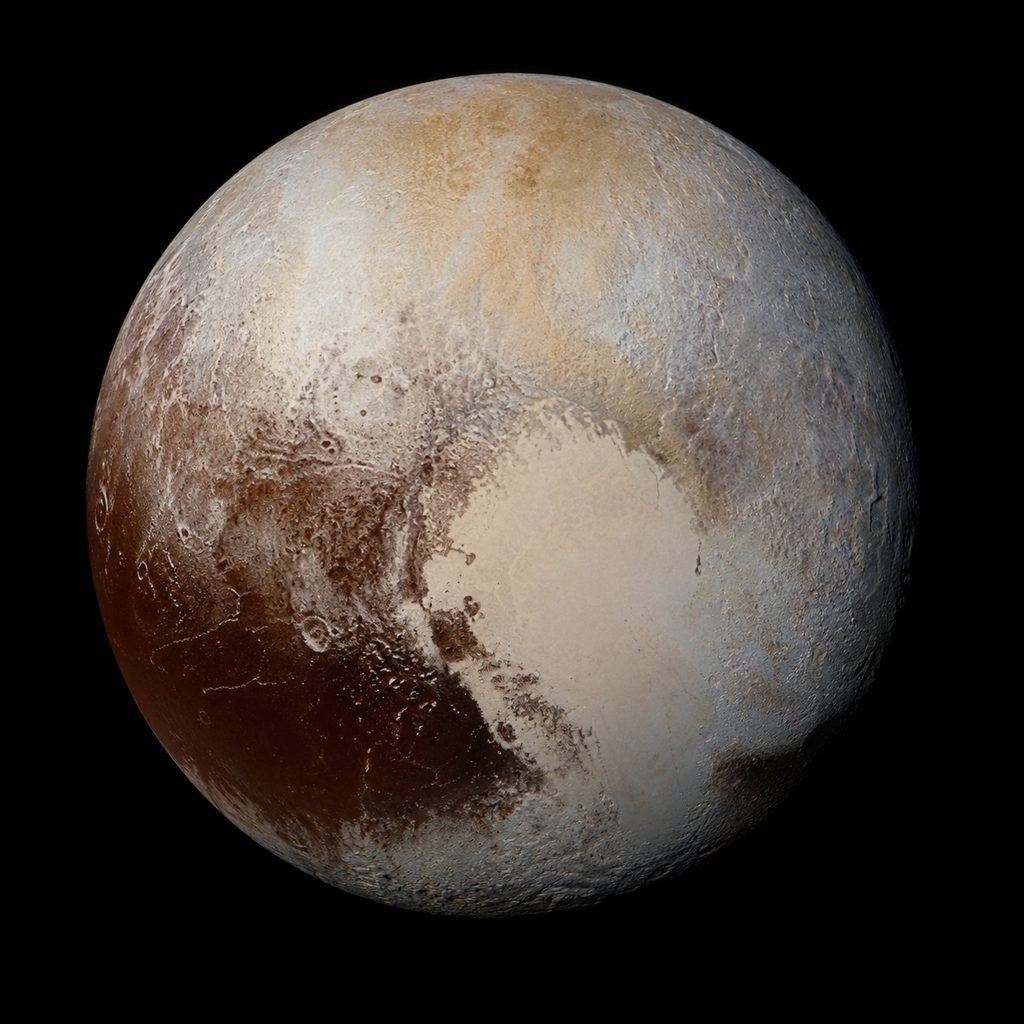
The high-resolution photographs beamed back to Earth left the global scientific community absolutely speechless. Instead of a dead, heavily cratered, frozen rock, dwarf planet Pluto was revealed to be a breathtakingly beautiful, geologically alive, and highly dynamic world. The most famous feature captured by the probe was Tombaugh Regio, a massive, brilliant white, heart-shaped glacier dominating the surface.
The left lobe of this heart, known as Sputnik Planitia, is a vast, smooth plain of frozen nitrogen completely devoid of impact craters. This lack of craters indicates that the surface is incredibly young and is being constantly renewed by active geological processes, likely driven by a slow, churning convection of soft nitrogen ice from a deep subsurface heat source. Surrounding these smooth nitrogen plains are towering, jagged mountain ranges (such as Tenzing Montes and Hillary Montes) that reach heights of 3,500 meters. Remarkably, because temperatures are so low, these mountains are not made of rock; they are forged entirely from rock-hard water ice. The surface is also stained with a reddish hue, caused by complex organic molecules called tholins, which are created when ultraviolet sunlight reacts with methane in the thin atmosphere.
7. Charon and the Complex Moon System
No discussion of this distant world is complete without exploring its incredibly complex system of natural satellites. Despite its tiny size, it possesses five known moons: Charon, Nix, Hydra, Kerberos, and Styx.
Charon, the largest moon, is the true standout. Discovered in 1978, Charon is incredibly massive relative to its host body—its diameter is just over half the size of the host itself. Because Charon is so large and heavy, its gravity pulls the center of mass (the barycenter) of the system outside the surface of the main body. As a result, the two celestial bodies actually orbit a shared empty point in space, locked in a continuous gravitational waltz. This makes them a true “binary” or double planetary system, a phenomenon unique in our solar system.
The New Horizons flyby revealed that Charon is a fascinating world in its own right. Its surface is fractured by massive tectonic canyons that stretch for over 1,000 kilometers, and its northern pole features a dark, mysterious, reddish stain named Macula Mordor. The other four moons—Nix, Hydra, Kerberos, and Styx—are tiny, irregularly shaped chunks of ice that tumble chaotically in the outer edges of the system, likely the shattered debris from an ancient, cataclysmic collision that originally formed Charon.
8. Beyond the Ninth: The Future of Outer Solar System Exploration
The historic reclassification and the breathtaking New Horizons flyby did not mark the end of our fascination with the outer solar system; rather, it was just the beginning. The demotion brought widespread attention to the incredible diversity of the Kuiper Belt.
Today, astronomers are actively studying other fascinating members of this new classification. Eris, the massive, highly reflective world that triggered the great debate, possesses its own moon named Dysnomia. Haumea is a bizarre, rapidly spinning, egg-shaped world with its own ring system. Makemake is a reddish, methane-rich sphere, and Ceres (the only dwarf located in the inner solar system’s asteroid belt) is believed to harbor a deep, salty ocean beneath its icy crust.
As telescope technology continues to advance, particularly with the deployment of the James Webb Space Telescope, we are peering deeper into the Kuiper Belt than ever before. We are searching for new, undiscovered icy worlds and investigating the chemical composition of their faint atmospheres. Ultimately, understanding the complex geology, atmospheric dynamics, and chaotic history of dwarf planet Pluto and its icy Kuiper Belt neighbors provides us with a pristine, frozen window into the very birth of our solar system, reminding us that there is still so much incredible beauty waiting to be discovered in the dark.
Leave a Reply