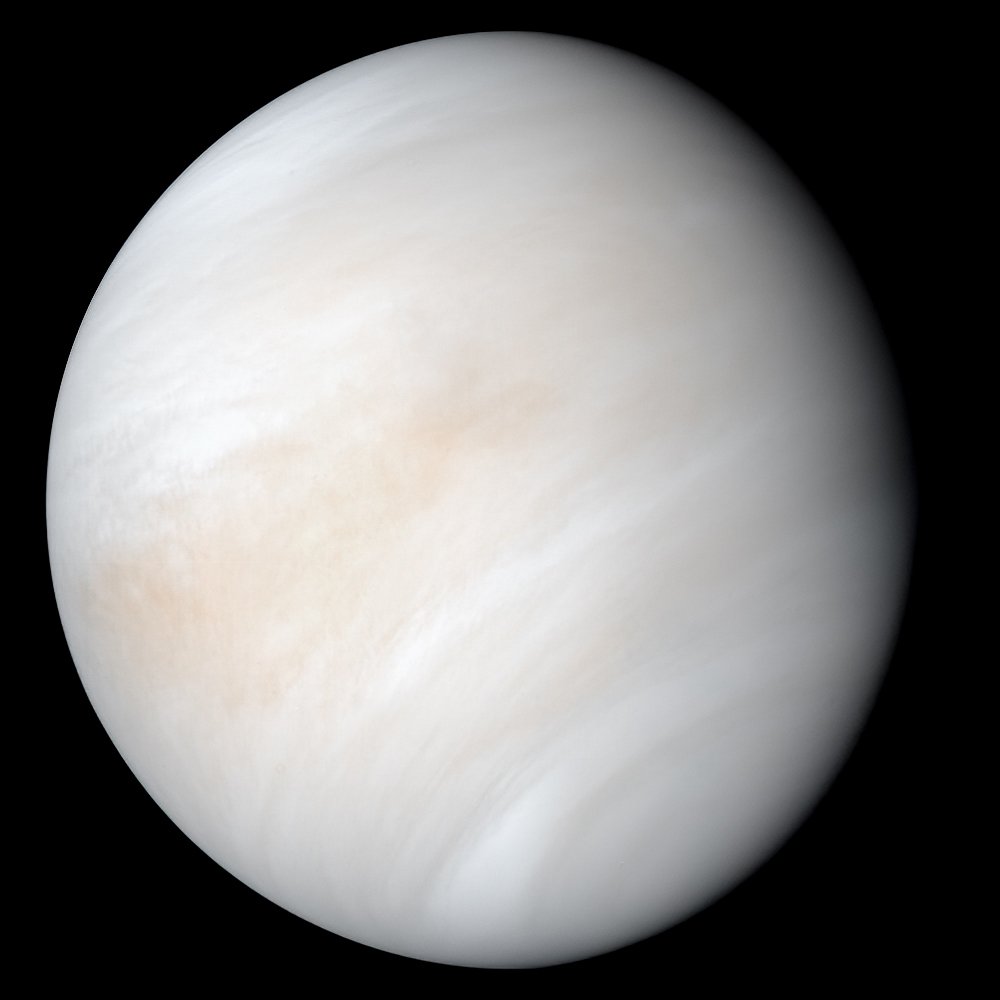
When gazing at the evening or early morning sky, the absolute brightest celestial object after our Moon is almost always planet Venus. For millennia, this dazzling beacon has captivated human imagination. Ancient astronomers, noticing its piercing brilliance at different times of the day, originally thought it was two separate stars—the Morning Star (Phosphorus) and the Evening Star (Hesperus). Because it is our closest planetary neighbor and remarkably similar to Earth in both size and mass, it has frequently and affectionately been called Earth’s twin.
However, this nickname is tragically misleading. Beneath its brilliant, beautiful, and highly reflective cloud cover lies a hostile, hellish world characterized by extreme temperatures, crushing atmospheric pressure, and a runaway greenhouse effect that makes the existence of life as we know it absolutely impossible. In this comprehensive post, we will deeply explore the detailed physical specifications, the highly toxic atmosphere, the bizarre orbital mechanics, the hidden volcanic topography, the dramatic history of its robotic exploration, and the sheer joy of observing this brilliant world.
1. Core Specifications of Planet Venus
To truly understand this extreme, oppressive environment, we must first look at its fundamental physical numbers. Despite its striking similarities to Earth in terms of bulk mass and physical dimensions, its surface conditions are vastly and terrifyingly different.
Here are the detailed physical characteristics that define this hellish twin:
| Feature | Specification Details |
| Equatorial Diameter | 12,103.6 km (Roughly 95% of Earth’s diameter) |
| Mass & Density | 4.868 × 10²⁴ kg / 5.243 g/cm³ |
| Atmospheric Pressure | 9.3 MPa (Over 90 times Earth’s sea-level pressure) |
| Atmospheric Composition | 96.5% Carbon Dioxide, 3.5% Nitrogen, traces of Sulfur Dioxide |
| Average Temperature | 737 K (464°C), effectively uniform globally |
| Orbital Period | 224.7 Earth days |
| Rotation Period | 243.023 Earth days (Retrograde rotation) |
At the surface, the physical conditions are completely alien. The atmospheric pressure is 90 times greater than what we experience on Earth. Standing on its surface would feel equivalent to the crushing, immense physical pressure felt 800 meters (about half a mile) deep in Earth’s oceans. A human would be simultaneously crushed, roasted, and dissolved in a matter of seconds.
2. A Hellish Atmosphere and the Runaway Greenhouse Effect
The most defining and terrifying characteristic of this world is its incredibly thick and toxic atmosphere. The atmosphere is predominantly composed of 96.5% carbon dioxide, which creates the most extreme runaway greenhouse effect ever observed in the solar system.
This unbelievably dense blanket of carbon dioxide traps incoming solar heat with terrifying efficiency, raising the average surface temperature to a staggering 464°C (867°F). This means the surface of planet Venus is actually hotter than Mercury, even though Mercury is twice as close to the Sun. Furthermore, the thick atmosphere distributes this heat so evenly that there are essentially no temperature differences between the equator and the poles, or even between day and night. It is a constant, unyielding inferno.
High above the surface, thick clouds composed entirely of highly corrosive sulfuric acid completely envelop the globe. These clouds reflect about 70% of all incoming sunlight, which is why the planet appears so incredibly bright in our night sky. Interestingly, it rains sulfuric acid on this world, but because the surface is so hot, the acid raindrops completely evaporate miles before they ever reach the ground—a bizarre meteorological phenomenon known as “virga.”
Astronomers firmly believe it wasn’t always like this. Billions of years ago, when the young Sun was dimmer, this planet likely had a climate very similar to Earth’s, potentially featuring shallow, liquid water oceans. However, as the Sun gradually grew hotter over billions of years, these ancient oceans evaporated into the atmosphere. The massive amount of water vapor acted as a potent greenhouse gas, accelerating the heating process. Eventually, solar ultraviolet radiation broke the water molecules apart; the light hydrogen atoms escaped into deep space, while the heavy carbon dioxide was left behind to permanently dominate the dead atmosphere.
3. Bizarre Rotation and Orbital Mechanics
The orbital behavior of planet Venus is one of the most peculiar and mind-bending phenomena in the entire solar system. First, it boasts the most perfectly circular orbit of any major planet, with a minuscule eccentricity of just 0.0068.
Even more bizarre is its rotation. It spins completely backwards (retrograde rotation) on its axis, which is tilted at an extreme 177 degrees. If you could magically survive on the surface, you would see the Sun rise in the west and slowly set in the east.
Furthermore, it rotates incredibly, agonizingly slowly. It takes 243 Earth days to complete just one single rotation on its axis, but it only takes about 225 Earth days to complete one full orbit around the Sun. Consequently, a single sidereal day on this world is actually longer than its entire year! Scientists largely attribute this slow, reverse spin to ancient gravitational perturbations, a potential catastrophic collision with a massive protoplanet billions of years ago, and the immense tidal friction generated by the Sun pulling on its incredibly thick, heavy atmosphere.
While the solid planet rotates at a snail’s pace, the upper atmosphere exhibits a phenomenon known as “super-rotation.” High-altitude winds whip around the entire globe at terrifying speeds of up to 300 kilometers per hour (186 mph), circling the planet in just four Earth days.
4. Internal Structure, Volcanic Resurfacing, and Topography
For a long time, the dense, opaque clouds completely hid the surface from optical telescopes. However, modern radar technology, most notably NASA’s Magellan spacecraft in the early 1990s, eventually pierced the veil, revealing a rocky, violently resurfaced landscape.
- Surface Features: The topography is divided into rolling volcanic plains, deep rift valleys, and massive highlands. The northern hemisphere features a continent-sized highland called Ishtar Terra, while the southern hemisphere contains the even larger Aphrodite Terra. Interestingly, there are far fewer impact craters compared to the Moon or Mars.
- Volcanic Resurfacing: The mysterious lack of old impact craters suggests a massive, global planetary resurfacing event. Unlike Earth, this world does not have active plate tectonics to slowly release internal heat. Instead, heat builds up beneath the thick crust until it undergoes a catastrophic, global volcanic eruption. Calculations indicate that around 500 million years ago, immense lava flows paved over the older, cratered crust, giving the entire planet a geological “facelift.”
- Bizarre Geology: The surface is littered with thousands of massive shield volcanoes and bizarre geological formations not found on Earth, such as “pancake domes” (flat, circular domes created by the eruption of extremely thick, sluggish lava) and “arachnoids” (spider-like networks of fractures).
- Internal Anatomy & Magnetic Field: Its interior is assumed to be very similar to Earth’s, possessing a rocky crust, a silicate mantle, and a partially molten iron-nickel core. However, despite having a molten metallic core, the extremely slow rotation prevents the internal dynamo effect from occurring, resulting in no measurable global magnetic field.
5. The History of Robotic Exploration
Exploring the hostile environment of planet Venus has been one of the greatest engineering challenges in the history of spaceflight. During the Cold War, the Soviet Union launched the Venera program, a series of heavily armored robotic probes specifically designed to withstand the hellish conditions.
In 1970, Venera 7 became the first spacecraft to successfully land on another planet and transmit data back to Earth. Later missions, like Venera 13 in 1982, managed to survive the crushing pressure and searing heat for roughly two hours before their internal electronics literally melted and failed. In those brief, precious minutes, they captured the first and only color photographs of the surface, revealing a barren, alien landscape of fractured basaltic rocks bathed in a sickly, yellowish-orange light filtered through the thick clouds.
More recently, the scientific community was shocked when astronomers detected traces of phosphine gas high in the planet’s atmosphere—a chemical that, on Earth, is primarily produced by living anaerobic microbes. While this sparked intense debate about the potential for extreme microbial life surviving high in the more temperate upper clouds, the existence of biological life remains unconfirmed and highly controversial.
6. The Brilliant Jewel of the Sky: Observing Planet Venus
Unlike the highly elusive and difficult-to-spot Mercury, observing this magnificent twin planet is an absolute delight for anyone who looks up. Thanks to its highly reflective cloud cover and close orbital proximity to Earth, it outshines every other star and planet in the night sky. In fact, if you see a single, impossibly bright, unblinking “star” piercing through the evening twilight, it is almost certainly this world! I often step outside to admire it with my own naked eyes, completely captivated by its steady, piercing brilliance.
Because its orbit lies inside Earth’s, it never wanders too far from the Sun from our perspective. You can easily spot it either low in the western sky shortly after sunset (affectionately called the Evening Star) or in the eastern sky just before sunrise (the Morning Star).
When observed through a telescope, it doesn’t reveal surface details due to its thick clouds, but it does exhibit distinct phases, exactly like our Moon. Watching it change from a tiny, full disk to a large, thin crescent as it approaches Earth is a mesmerizing experience. In fact, it was the observation of these exact phases by Galileo Galilei in 1610 that provided the ultimate, irrefutable proof that the planets orbit the Sun, permanently changing our understanding of the cosmos. Today, it remains so luminous and beautiful that you don’t even need a telescope; just looking up at the right time provides a breathtaking connection to our closest planetary neighbor.
Leave a Reply