When we look at the standard model of our solar system, the eight major celestial bodies orbiting the Sun are often divided into distinct groups. The inner system is dominated by the rocky terrestrial worlds, while the outer system is the realm of the massive giants. Sitting at the very edge of this planetary neighborhood, approximately 4.5 billion kilometers away from the warming rays of the Sun, is a stunningly beautiful, deep azure world.
As the eighth and farthest officially recognized rock from the Sun, planet Neptune is a fascinating “ice giant” shrouded in freezing temperatures, raging supersonic winds, and centuries of astronomical mystery. Named after the Roman god of the sea due to its vivid ocean-blue color, this distant world holds a unique place in the history of science. In this deeply comprehensive guide, we will explore the mathematical triumph of its discovery, its freezing and chaotic atmosphere, the bizarre internal structure, the faint rings, and the mysterious backward-orbiting moon that was likely kidnapped from the deep reaches of space.
1. A Triumph of Mathematics: The Discovery
The discovery of this distant ice giant is one of the greatest triumphs of mathematical astronomy in human history. Unlike every other planet before it, it was not discovered by someone simply pointing a telescope at the sky and spotting a new point of light. It was discovered using pure mathematics.
After William Herschel discovered Uranus in 1781, astronomers closely tracked its orbit for decades. However, they noticed something baffling: Uranus was not following the exact path predicted by Newton’s laws of gravity. Something unknown and massive was gravitationally pulling on Uranus, causing an unexplained orbital perturbation.
In 1843, a brilliant young British astronomy student named John Couch Adams mathematically predicted the existence and location of a mysterious eighth planet beyond Uranus. Unfortunately, the British Royal Observatory largely ignored the young student’s calculations. Two years later, in 1845, a French mathematician named Urbain Le Verrier independently reached the exact same conclusion and published his findings.
Frustrated by the lack of action in France, Le Verrier mailed his coordinates to the Berlin Observatory. On the night of September 23, 1846, German astronomer Johann Galle pointed his telescope exactly where Le Verrier’s math said to look, and within an hour, he discovered the 8th-magnitude dot of light. A fierce nationalistic debate immediately erupted between Britain and France over who deserved the credit. Today, history rightfully honors both Adams and Le Verrier as the joint theoretical discoverers of this distant blue world.
2. Core Specifications of Planet Neptune
To understand the nature of this frigid world, we must examine its physical specifications. It is incredibly similar to Uranus in size and composition, making them planetary twins, though it is slightly smaller in diameter but significantly more massive and dense.
Here are the detailed physical specifications that define this distant ice giant:
| Feature | Specification Details |
| Equatorial Diameter | 49,528 km (Nearly 4 times Earth’s diameter) |
| Mass | Approximately 17 times the mass of Earth (1.02 × 10²⁶ kg) |
| Average Density | 1.638 g/cm³ (The highest density of all the giant planets) |
| Atmospheric Composition | 80% Hydrogen, 19% Helium, trace amounts of Methane |
| Average Temperature | -214°C |
| Orbital Period (Year) | 163.7 Earth years |
| Rotation Period (Day) | 16.08 hours |
| Axial Tilt | 28.32 degrees (Producing distinct seasons) |
Beneath the freezing cloud tops, the internal structure is assumed to be very similar to that of Uranus. Because the internal pressure is relatively low compared to Jupiter or Saturn, astronomers believe there is no liquid metallic hydrogen inside. Instead, below the atmosphere, there is likely a massive, electrically conductive, slushy mantle composed of water, ammonia, and methane ices. At the very center lies a solid core of rock and ice, roughly the mass of Earth.
3. The Raging Blue Atmosphere and The Great Dark Spot
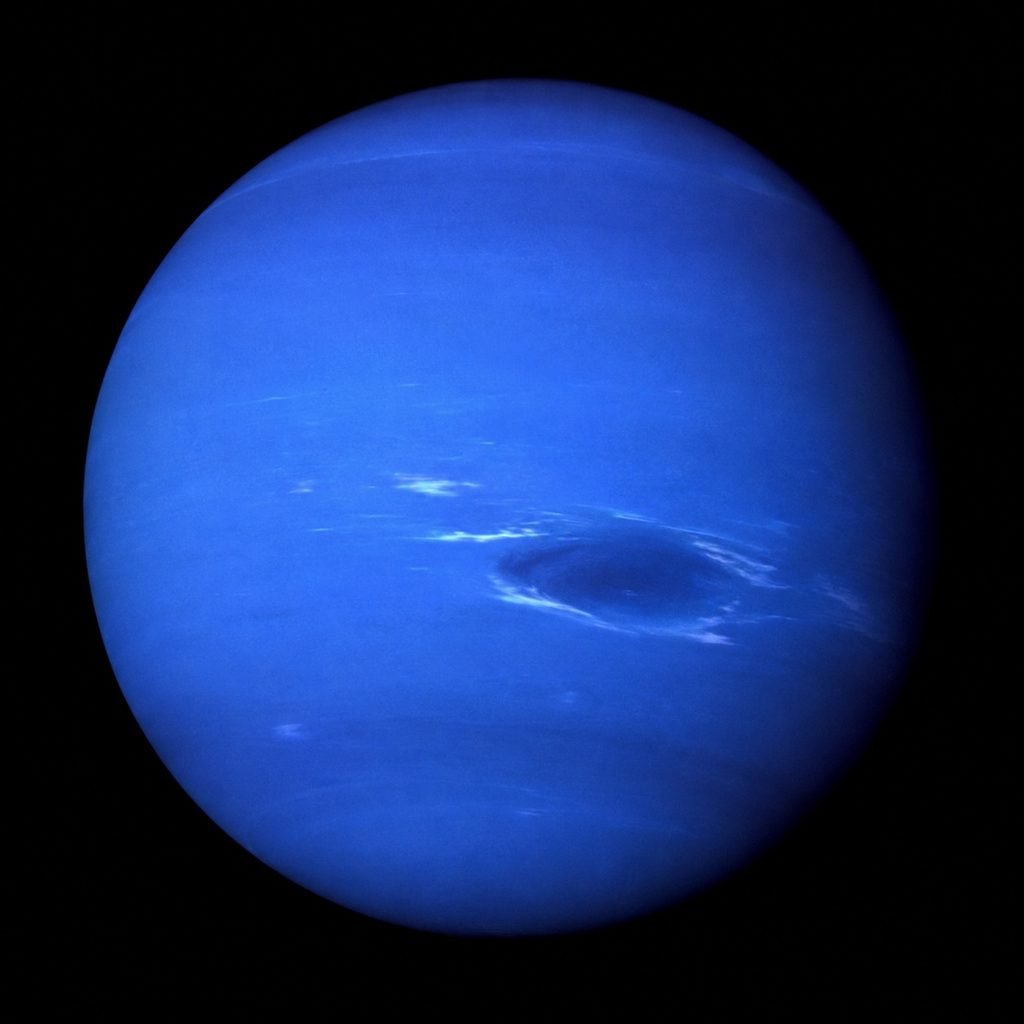
The most striking visual feature of planet Neptune is its vibrant, deep blue color. The atmosphere is composed of roughly 80% hydrogen, 19% helium, and small but critical amounts of ethane and methane. Just like Uranus, the methane gas absorbs the red wavelengths of sunlight and reflects the blue light back into space. However, this world’s blue is much deeper and more vivid than Uranus’s pale cyan, leading scientists to suspect that another, currently unknown atmospheric chemical is enhancing the deep azure hue.
Despite being further from the Sun and receiving very little solar energy, the atmosphere here is shockingly active and violent. In fact, it boasts the fastest winds ever recorded in the solar system, with terrifying supersonic storms roaring at speeds of up to 2,100 kilometers per hour (1,300 mph).
When the Voyager 2 spacecraft flew by in 1989, it photographed a massive, swirling anticyclonic storm in the southern hemisphere, which was named the “Great Dark Spot.” This dark, gaping hole in the methane clouds was roughly the size of Earth, functioning similarly to Jupiter’s Great Red Spot. However, unlike Jupiter’s centuries-old storm, this dark vortex is highly transient. When the Hubble Space Telescope looked for it a few years later, the Great Dark Spot had completely vanished, only for a new dark spot to appear in the northern hemisphere, proving that this atmosphere is incredibly chaotic and rapidly changing.
4. The Mystery of the Internal Heat
One of the great scientific mysteries regarding this blue giant is its internal temperature. Although it orbits 1.5 billion kilometers further from the Sun than Uranus, its average atmospheric temperature is almost identical (-214°C). This means it is emitting a massive amount of excess energy.
In fact, it radiates more than 2.6 times the thermal energy into space than it receives from the distant Sun. Astronomers theorize that, like Jupiter and Saturn, this internal heat is a remnant of the planet’s initial formation 4.6 billion years ago. The planet is still slowly contracting under its own gravity, and this ongoing gravitational compression releases immense internal heat. This powerful internal heat source rising up from the core is the primary engine driving the terrifying, supersonic winds in the upper atmosphere.
5. An Off-Center Magnetic Field and Faint Rings
Much like Uranus, the magnetic field here is highly irregular and completely misaligned. While Earth’s magnetic axis is roughly aligned with its rotation axis, the magnetic field of planet Neptune is tilted at an extreme angle of 47 degrees relative to its rotation. Furthermore, the magnetic field does not originate from the physical center of the core; it is shifted off-center by at least half the planet’s radius. Scientists believe this bizarre magnetic field is generated by convective fluid motions in the thin, slushy mantle of electrically conductive water and ammonia, rather than in the deep core.
Additionally, this world possesses a very faint and elusive ring system. Because the rings are extremely dark and thin, they were only first suspected from Earth when astronomers noticed the starlight flickering before the planet passed in front of a background star (stellar occultation). However, it wasn’t until Voyager 2 arrived that humanity finally got a clear look at them. The rings are composed of dark dust particles and microscopic organic compounds, and they uniquely feature thick, clumped “arcs” of material that have puzzled dynamicists for decades.
6. Triton: The Captured, Backward-Orbiting Moon
Like the other giant planets, this world possesses a complex system of natural satellites. However, one moon completely dominates the system: Triton. Discovered in 1846 by William Lassell just 17 days after the planet itself was found, Triton was appropriately named after the mythological Greek sea god, son of Poseidon.
Triton is absolutely massive. With a diameter of 2,710 kilometers, it is significantly larger than Earth’s Moon and possesses a mass of roughly 2.16 × 10²² kg. However, what makes Triton truly unique among all the large moons in the solar system is its bizarre orbital mechanics. Triton orbits the planet in a retrograde direction, meaning it travels in the opposite direction of the planet’s rotation. Furthermore, its orbit is highly tilted by 20 degrees relative to the planet’s equator.
Because a moon that forms naturally alongside its host planet from a primordial debris disc will always orbit in the same direction as the planet’s spin, Triton’s retrograde orbit is a massive red flag. Astrophysicists have concluded that Triton did not form here. Instead, Triton is actually a massive icy dwarf planet that originally formed in the distant Kuiper Belt. Billions of years ago, it wandered too close and was permanently captured by the ice giant’s immense gravitational pull.
7. The Ice Volcanoes of Triton
When examining the retinue of planet Neptune, Triton is also one of the very few moons in the solar system (along with Jupiter’s Io and Saturn’s Titan) known to possess a significant, albeit thin, atmosphere composed mostly of nitrogen.
When Voyager 2 flew past Triton, the scientific community was absolutely stunned by what the photographs revealed. Instead of a dead, heavily cratered world, Triton was shockingly bright, tinted with pink and pale blue hues. Most importantly, the spacecraft captured active cryovolcanism (ice volcanoes). Voyager 2 photographed massive plumes of dark, freezing nitrogen gas and dust erupting several kilometers high into the thin atmosphere before being carried away by high-altitude winds and settling back onto the icy surface. The discovery of these active ice volcanoes, along with lakes of frozen methane and ammonia, proved that Triton is a geologically alive and dynamically active world, heated by the intense tidal friction generated by its bizarre retrograde orbit.
8. The Historic Legacy of Voyager 2
Because of the staggering distance of 4.5 billion kilometers from Earth, exploring planet Neptune is a monumental engineering challenge. To this day, only one spacecraft has ever visited it. After a grueling 12-year journey across the solar system, NASA’s Voyager 2 spacecraft finally made its historic, closest approach on August 25, 1989, skimming just 4,950 kilometers above the planet’s north pole.
The thousands of photographs and streams of data beamed back by Voyager 2 fundamentally rewrote our understanding of the outer solar system. It revealed the supersonic winds, discovered the Great Dark Spot, mapped the faint ring system, and captured the erupting ice volcanoes on Triton. To this day, everything we know in high resolution about this distant blue giant comes from that single, fleeting encounter in the summer of 1989.
As we look toward the future of space exploration, the astronomical community is actively campaigning for a dedicated flagship orbiter to return to this fascinating world. Until that next robotic emissary launches, we will continue to point our Earth-bound telescopes and the James Webb Space Telescope at this distant, azure sphere, marveling at the freezing, chaotic secrets it still holds.
Leave a Reply