Whenever we watch blockbuster science fiction movies, traversing the space between Mars and Jupiter is often depicted as a terrifying, high-stakes navigational nightmare. Spaceships are shown frantically dodging and weaving through a densely packed minefield of tumbling rocks and massive boulders crashing into one another. However, the true astronomical reality of this vast region is far more fascinating, scientifically rich, and surprisingly empty than Hollywood would have us believe.
Sitting like a boundary line between the inner rocky planets and the outer gas giants, the asteroid belt is a massive circumstellar disc composed of millions of rocky fragments, metallic bodies, and icy remnants. Rather than being a navigational hazard, this region serves as a pristine, untouched cosmic time capsule. It preserves the original building blocks of our planetary system from 4.6 billion years ago. In this deeply comprehensive guide, we will explore the precise physical specifications of this region, the destructive gravitational forces that prevented these rocks from becoming a planet, the fascinating dwarf planet hidden within it, the economic promise of space mining, and the reality of the near-Earth impact threat.
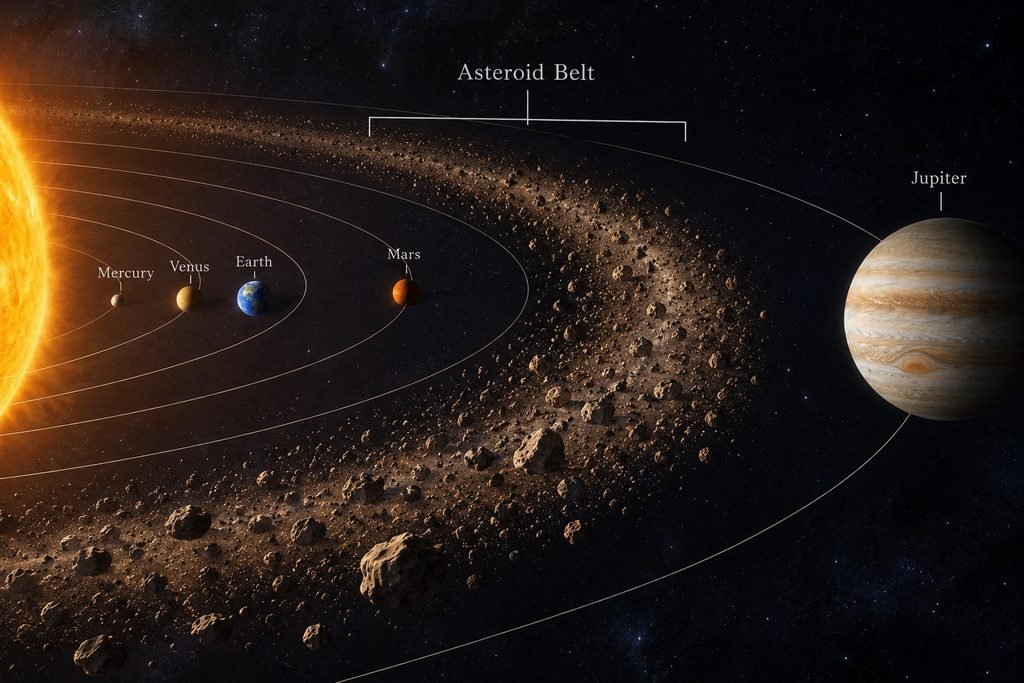
1. Core Specifications of The Asteroid Belt
To truly understand this vast cosmic ring, we must first look at its scale and physical distribution. While it spans an unimaginably large volume of space, the actual amount of physical matter contained within it is surprisingly small.
Here are the detailed physical specifications that define this rocky debris field:
| Feature | Specification Details |
| Location | Between the orbits of Mars and Jupiter |
| Distance from the Sun | Roughly 2.2 to 3.2 Astronomical Units (AU) |
| Total Mass | ~4% of the mass of Earth’s Moon |
| Composition Distribution | 75% Carbonaceous (C-type), 17% Silicate (S-type), 10% Metallic (M-type) |
| Largest Object | Ceres (Classified as a Dwarf Planet) |
| Average Distance Between Asteroids | Approximately 1 to 3 million kilometers |
| Orbital Period | Ranges from 3 to 6 Earth years depending on the distance from the Sun |
The most shocking statistic to most people is the total mass. If you were to gather every single asteroid, rock, and speck of dust in this entire massive region and crush them together into a single sphere, the resulting celestial body would still be significantly smaller than Earth’s Moon. In fact, just four objects—Ceres, Vesta, Pallas, and Hygiea—contain over half of the entire mass of the belt.
2. Formation: The Planet That Never Was
A common misconception is that this debris field is the shattered remains of a fully formed planet that was destroyed by a catastrophic collision or the Death Star. However, modern astrophysics tells us the exact opposite story. This is not a destroyed planet; it is a planet that was never allowed to form in the first place.
Approximately 4.6 billion years ago, the solar system was a swirling disc of gas and dust known as the solar nebula. In the inner regions, dust grains collided and gently clumped together (a process called accretion) to form the terrestrial planets like Earth and Venus. In the outer regions, it was cold enough for gases and ice to accumulate, forming the massive gas giants.
In the region between Mars and Jupiter, the rocky material also began to clump together, forming smaller bodies called planetesimals. However, a massive gravitational bully nearby completely derailed this process. Jupiter, the newly formed gas giant, possessed immense gravitational power. As Jupiter orbited, its massive gravitational resonance constantly swept through this region. Instead of allowing the planetesimals to gently merge and grow into a single, large Earth-sized planet, Jupiter’s gravity accelerated these rocks to blistering speeds. When these fast-moving bodies crossed paths, they didn’t merge; they smashed into each other with catastrophic force, shattering into smaller and smaller pieces. To this day, Jupiter’s gravitational influence continues to stir this region, preventing the remaining fragments from ever coalescing.
3. The Composition and Types of Space Rocks
Not all space rocks are created equal. The objects in this region are categorized into three broad classes based on their chemical composition and how they reflect sunlight (albedo). These variations tell astronomers a great deal about the temperature gradients and chemical distribution of the early solar nebula.
- C-type (Carbonaceous) Asteroids: Making up roughly 75% of the known population, these are the most common objects. They are extremely dark, reflecting very little light, and are rich in carbon and volatile compounds. They are considered the most ancient and pristine remnants of the early solar system. Many scientists believe that C-type asteroids crashing into the early Earth billions of years ago may have delivered the precious water that now fills our oceans.
- S-type (Silicate) Asteroids: Comprising about 17% of the population, these are stony objects made primarily of silicate minerals and nickel-iron. They are much brighter and more reflective than C-types and are found closer to the inner edge of the belt.
- M-type (Metallic) Asteroids: Making up roughly 10%, these are the rarest and most economically intriguing. They are composed almost entirely of pure nickel and iron. Astronomers believe these metallic bodies are the shattered, exposed cores of ancient protoplanets that were destroyed in massive collisions before they could fully form.
4. Ceres: The Dwarf Planet of the Belt
While the vast majority of objects here are irregularly shaped, potato-like rubble, there is one undeniable king of this region: Ceres. Discovered in 1801 by Giuseppe Piazzi, Ceres was originally classified as a planet, then downgraded to an asteroid, and finally reclassified as a “dwarf planet” by the International Astronomical Union in 2006, sharing the same category as Pluto.
Ceres is massive enough that its own gravity has pulled it into a nearly perfect sphere. With a diameter of 940 kilometers, it alone accounts for about one-third of the total mass of the entire belt. In 2015, NASA’s Dawn spacecraft arrived at Ceres and completely revolutionized our understanding of it. Instead of a dead, dry rock, Dawn revealed a geologically complex world.
The spacecraft captured stunning images of bright, glowing spots inside the Occator Crater, which turned out to be massive deposits of sodium carbonate salts left behind by cryovolcanoes (ice volcanoes) erupting briny water onto the surface. The presence of these salts and ammonia-rich clays strongly suggests that Ceres possesses a deep, subsurface ocean of salty liquid water beneath its icy crust. This astonishing discovery has elevated Ceres to a prime target in the ongoing search for extraterrestrial microbial life.
5. Vesta, Pallas, and Hygiea: The Massive Minor Planets
Beyond Ceres, there are three other behemoths that dominate the mass distribution of this region.
The second-largest object is Vesta. Measuring about 525 kilometers in diameter, Vesta is unique because it is the only known remaining rocky protoplanet (with a differentiated crust, mantle, and core) that survived the chaotic early days of the solar system. Vesta suffered a colossal impact at its south pole billions of years ago, creating the massive Rheasilvia crater. This impact was so violent that it ejected roughly 1% of Vesta’s total mass into space, and many of these specific meteorites (known as HED meteorites) have actually crashed into Earth.
Pallas is the third-largest object and is famous for its highly unusual, tilted orbital path. While most objects orbit on the same flat plane as the planets, Pallas orbits at a steep 34-degree angle, making it incredibly difficult for spacecraft to visit. Finally, Hygiea is the fourth-largest member. Despite being smaller than Vesta and Pallas, observations in 2019 revealed that Hygiea is completely spherical, suggesting it may soon meet the criteria to be officially upgraded to a dwarf planet.
6. Dispelling the Navigational Minefield Myth
Returning to the science fiction movies, the idea that a spacecraft must aggressively maneuver to survive flying through this region is a complete myth. The total volume of space occupied by this region is so incomprehensibly massive that the rocks are spread incredibly thin.
In reality, the average distance between any two large asteroids is between 1 and 3 million kilometers—which is several times the distance between the Earth and the Moon. If you were standing on an asteroid and looking out into the void, you would likely not even be able to see another asteroid with the naked eye; the sky would simply look empty.
Since the 1970s, humanity has sent numerous probes directly through this region, including Pioneer 10, Voyager 1 and 2, Galileo, Cassini, and New Horizons. Not a single one of them was ever in danger of a collision. In fact, if a space agency actually wants a probe to fly close to an asteroid for observation, they have to carefully calculate and execute highly precise orbital maneuvers just to get close enough.
7. Kirkwood Gaps and the Near-Earth Impact Threat
While the asteroid belt is mostly stable, it is not entirely static. If you look at a map of the orbital distribution, you will notice distinct, empty lanes where almost no objects exist. These empty spaces are known as Kirkwood Gaps.
These gaps are created by orbital resonances with Jupiter. For instance, if an asteroid happens to orbit the Sun exactly three times for every one orbit of Jupiter (a 3:1 resonance), Jupiter’s massive gravity will repeatedly tug on the asteroid at the exact same point in its orbit. Over thousands of years, these repeated gravitational nudges destabilize the asteroid’s path, violently slingshotting it out of the gap.
Sometimes, these destabilized rocks are thrown outward into the freezing depths of space. Other times, they are hurled inward toward the Sun, crossing the orbits of Mars, Earth, and Venus. These are known as Near-Earth Asteroids (NEAs). While the vast majority burn up harmlessly in Earth’s atmosphere, occasionally a massive one makes it to the surface, as evidenced by the Chicxulub impactor that wiped out the dinosaurs 66 million years ago. Tracking these rogue, gravitationally nudged fragments is a major priority for global space defense agencies today.
8. The Future: Exploring and Mining The Asteroid Belt
Looking to the future, this rocky frontier is rapidly transitioning from a subject of pure scientific curiosity to a realm of immense economic potential. The concept of space mining is moving closer to reality.
M-type asteroids, which are the exposed metallic cores of shattered protoplanets, contain staggering amounts of precious metals, including platinum, gold, nickel, and iron. For example, the asteroid 16 Psyche is a massive metallic body roughly 220 kilometers wide. Scientists estimate that the raw iron and nickel contained within Psyche alone could theoretically be worth quintillions of dollars—enough to collapse and completely rebuild the global economy. NASA launched a dedicated spacecraft, also named Psyche, in 2023 to study this unique metallic world up close.
Furthermore, C-type asteroids are rich in water ice. In the future of space exploration, water is the ultimate currency. It can be consumed by astronauts, used to grow food, or broken down via solar electrolysis into liquid hydrogen and oxygen to create high-efficiency rocket fuel. Instead of launching heavy fuel from Earth’s deep gravity well, future spacecraft could stop at these floating “gas stations” to refuel before heading to Mars or the outer solar system.
Ultimately, understanding the mechanics, composition, and layout of this pristine cosmic time capsule is crucial. Not only does it provide a window into the violent, chaotic birth of our home planet, but it also holds the key to humanity’s future expansion into the cosmos, offering the limitless resources necessary to sustain a multi-planetary civilization.
Leave a Reply