Whenever astronomers look out into the vast, dark expanse of our solar system, one celestial body demands absolute attention. Ruling over the outer regions with its immense gravitational pull and chaotic, swirling storms, it is the undisputed king of our planetary neighborhood. Planet Jupiter is a world of superlatives—it is the largest, the most massive, and arguably the most dynamic planet orbiting our Sun. It is a mesmerizing gas giant that has fundamentally shaped the architecture of our entire solar system.
I will never forget the first time I aligned my 4-inch refractor telescope and peered through the eyepiece at this magnificent gas giant. Seeing the distinct equatorial bands and spotting its four bright Galilean moons lined up perfectly in orbit gave me profound chills; it looked exactly like a miniature solar system playing out in real-time. Although I didn’t have the photographic equipment to capture the moment, the visual memory of that crisp, tangible observation remains deeply etched in my mind.
In this comprehensive guide, we will explore the mind-boggling physical specifications, the violent atmospheric storms, the mysterious liquid metallic interior, the invisible but massive magnetic field, its crucial role as Earth’s gravitational shield, and the surprising discovery of its faint ring system.
1. Core Specifications of Planet Jupiter
To truly appreciate the sheer scale of this gas giant, we must look at its awe-inspiring numbers. It is so monstrously large that if you combined the mass of all the other planets, moons, and asteroids in the solar system, it would still be more than twice as massive as all of them put together.
Here are the detailed physical specifications that define this colossal world:
| Feature | Specification Details |
| Equatorial Diameter | 142,984 km (About 11 times Earth’s diameter) |
| Mass & Volume | Roughly 318 times Earth’s mass / 1,321 times Earth’s volume |
| Average Density | 1.326 g/cm³ (About a quarter of Earth’s density) |
| Atmospheric Composition | 89.8% Hydrogen, 10.2% Helium, traces of Methane and Ammonia |
| Surface (Cloud Top) Temp | Approximately -148°C |
| Orbital Period (Year) | 11.86 Earth years |
| Rotation Period (Day) | 9 hours, 55 minutes (Fastest in the solar system) |
Despite its immense mass, its density is surprisingly low—only about 24% of Earth’s density. This is because, much like the Sun, it is composed almost entirely of light elements like hydrogen and helium. In fact, many astronomers refer to it as a “failed star.” If it had been roughly 80 times more massive during its formation, the immense crushing pressure in its core would have ignited nuclear fusion, transforming our solar system into a binary star system.
2. A Bizarre Interior: Liquid Metallic Hydrogen
Because it is a gas giant, planet Jupiter does not have a true solid surface like Earth or Mars. If you were to parachute into its atmosphere, you would fall endlessly, experiencing exponentially increasing pressure and temperature until you were crushed and melted.
The internal structure is bizarre and defies normal Earth-bound chemistry. As you descend deep beneath the cloud tops, the crushing atmospheric pressure forces the hydrogen gas to compress into a dense fluid. Going even deeper, the pressure becomes so incredibly intense (millions of times greater than Earth’s atmospheric pressure) that the hydrogen molecules are literally crushed apart. The electrons are squeezed out of their atomic orbits and begin to flow freely, transforming the hydrogen into a highly conductive, exotic state of matter known as “liquid metallic hydrogen.” Scientists have only recently been able to recreate this state in laboratories using massive shockwaves.
Beneath this massive ocean of liquid metallic hydrogen, there is a transitional zone where helium rains down in small droplets. Finally, at the absolute center, scientists theorize there is a dense, superheated core composed of heavy elements, rock, and exotic ices, burning at temperatures hotter than the surface of the Sun.
3. The Fastest Spin and Internal Heat
The rotational mechanics here are nothing short of extreme. Despite its massive size, it boasts the fastest rotation of any planet in the solar system, completing a full day in just under 10 hours. Because it is mostly composed of gas and fluid, it experiences “differential rotation” just like the Sun. The equatorial regions spin faster (completing a rotation in 9 hours and 50 minutes) than the polar regions (9 hours and 55 minutes). This blistering rotational speed generates immense centrifugal force, causing the planet to visibly bulge at the equator, taking on an oblate spheroid shape rather than a perfect sphere. Its axial tilt is a mere 3 degrees, meaning it experiences virtually no seasonal changes.
Furthermore, this giant emits more thermal energy into space than it receives from the Sun. This indicates a massive internal heat source. The primary source of this heat is believed to be the Kelvin-Helmholtz mechanism—the slow, continuous gravitational contraction of the planet since its initial formation. As the gas slowly collapses inward under its own crushing weight, it releases immense amounts of gravitational potential energy in the form of heat, which drives the violent weather systems we see on the surface.
4. The Atmosphere, Belts, and Zones
When observing this gas giant through a telescope, the most striking feature is its beautifully striped appearance. The atmosphere is highly structured into alternating bands of dark and light clouds that run parallel to the equator, driven by fierce jet streams roaring at hundreds of kilometers per hour.
The darker, reddish-brown bands are called “belts.” Infrared observations have revealed that these belts represent areas of lower pressure where cooler gas is sinking deeper into the atmosphere. The lighter, whitish bands are called “zones.” These zones are regions of high pressure where warmer gas is rising rapidly, creating towering ammonia ice clouds high in the atmosphere. The complex chemical interactions between ammonia, methane, sulfur, and sunlight are what give these cloud bands their distinct, vibrant colors, ranging from stark white to deep reds and browns.
5. The Great Red Spot: A Centuries-Old Storm
Embedded within these turbulent atmospheric bands is the most famous meteorological phenomenon in the entire solar system: The Great Red Spot.
From the outside, it looks like an ordinary, albeit massive, swirling vortex. In reality, it is a colossal, persistent anticyclonic storm located in the southern hemisphere, trapped between two opposing jet streams. The sheer scale of this storm is terrifying; it is currently large enough to swallow the entire Earth whole. The winds at the outer edge of the storm rage at speeds nearing 100 meters per second (432 km/h), making it a highly dynamic and chaotic system.
Astronomers have been continuously observing the Great Red Spot for over 300 years since telescopes were first invented. However, recent observations by the Hubble Space Telescope and the Juno spacecraft have shown that the storm is gradually shrinking and becoming more circular. Whether this ancient storm will eventually dissipate entirely or stabilize at a smaller size remains one of the greatest ongoing mysteries of planetary atmospheric science.
6. A Monstrous Magnetosphere and Brilliant Auroras
Hidden from human eyes, planet Jupiter possesses the most powerful and massive magnetic field of any planet in the solar system. While Earth’s magnetic field is generated by a swirling core of molten iron, this giant’s magnetic field is powered by the massive, churning ocean of highly conductive liquid metallic hydrogen spinning rapidly deep within its interior.
This magnetic field creates an invisible, protective bubble called the magnetosphere. The size of this magnetosphere is truly incomprehensible. If it glowed in visible light, it would appear four times larger than the full Moon in our night sky, even though the planet is over 600 million kilometers away! It stretches out approximately 3 million kilometers toward the Sun, and its elongated tail is blown outward by the solar wind all the way past the orbit of Saturn.
This intense magnetic field acts as an enormous particle accelerator, trapping high-energy charged particles and creating deadly radiation belts that would instantly fry unshielded spacecraft. When these highly charged particles are funneled down into the polar regions and slam into the upper atmosphere, they create breathtaking, brilliant auroras (similar to Earth’s Northern and Southern Lights) that are hundreds of times more energetic than any aurora ever seen on Earth.
7. The Faint Ring System of Planet Jupiter
For a very long time, astronomers firmly believed that Saturn was the only planet blessed with a ring system. However, that assumption was dramatically shattered in 1979 when NASA’s Voyager 1 spacecraft flew past this gas giant and took backlit photographs, revealing a faint, ghostly ring system.
Why wasn’t it discovered sooner despite the planet’s close proximity to Earth? Unlike Saturn’s brilliant rings, which are made of highly reflective chunks of water ice, this ring system is incredibly thin, low-density, and exceedingly faint. Infrared observations have confirmed that it is composed almost entirely of fine, dark rocky dust particles.
The ring system is divided into three main components: a thick inner torus called the halo, a relatively bright main ring, and a wide, faint outer gossamer ring. These rings extend up to 220,000 kilometers from the surface. The rings are not permanent structures; the dust is constantly spiraling into the atmosphere due to gravitational and magnetic forces. They are continuously replenished by fresh dust kicked up when high-velocity micrometeorites smash into the planet’s small inner moons.
8. Earth’s Cosmic Shield and Shoemaker-Levy 9
Beyond its fascinating atmospheric features, this massive gas giant plays a profoundly critical, life-saving role for our entire planet. Because of its immense mass, it possesses an incredibly strong gravitational pull that heavily influences the orbital paths of asteroids and comets entering the inner solar system.
Often referred to as the “vacuum cleaner” or the “cosmic shield” of the solar system, it aggressively attracts rogue celestial bodies, either completely ejecting them out of the solar system or pulling them in to crash into its own surface. Without this massive gravitational bodyguard absorbing or deflecting these dangerous projectiles, the inner planets—including Earth—would be struck by devastating asteroid and comet impacts far more frequently, potentially making the evolution and survival of complex life on Earth impossible.
The sheer power of this cosmic shield was spectacularly demonstrated in July 1994, during the historic Shoemaker-Levy 9 comet collision. Astronomers discovered that the gas giant’s immense tidal forces had completely torn a comet into a string of 21 fragments. The entire world watched in absolute awe as these fragments, some plunging at speeds of 60 kilometers per second, slammed violently into the planet’s southern hemisphere. The impacts created massive, dark, Earth-sized “scars” in the planet’s atmosphere that lingered for months. This terrifying and awe-inspiring event proved once and for all that our solar system is still a highly active and dangerous shooting gallery, and we owe a great deal of our safety to the gravitational protection of this giant neighbor.
9. A Miniature Solar System: The Galilean Moons
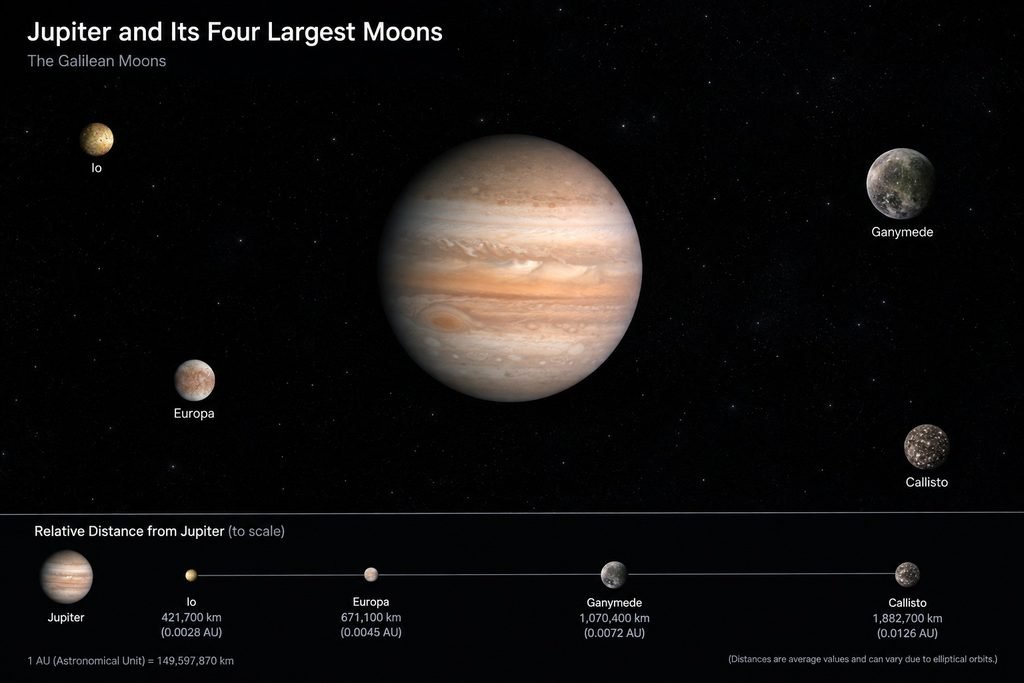
No discussion of this world is complete without mentioning its incredible retinue of natural satellites. It possesses dozens of moons, but the four largest—Io, Europa, Ganymede, and Callisto—are collectively known as the Galilean moons, named after Galileo Galilei, who discovered them in 1610. As I mentioned earlier, seeing them through my own 4-inch refractor was a profoundly moving experience.
These moons are diverse, dynamic worlds in their own right. Io is the most volcanically active body in the solar system, constantly erupting sulfur due to intense tidal heating. Europa hides a massive, deep ocean of liquid water beneath its cracked icy crust, making it a prime candidate in the search for extraterrestrial life. Ganymede is the absolute largest moon in the solar system (even larger than the planet Mercury) and the only moon known to possess its own magnetic field. Finally, heavily cratered Callisto is believed to be a dead, ancient world, offering a pristine record of the early solar system’s violent history.
Studying this magnificent gas giant and its diverse moons continues to provide astronomers with critical insights into how our solar system formed, how gas giants behave, and where we might find the ingredients for life in the dark depths of space.
Leave a Reply