Whenever humanity looks up at the night sky, one celestial object consistently captures our collective imagination more than any other. Shining with a distinct, blood-red hue against the backdrop of distant stars, this fascinating world has been the subject of countless myths, science fiction novels, and ambitious spaceflight programs. As the fourth rock from the Sun, planet Mars sits on the outer edge of the circumstellar habitable zone. For centuries, astronomers have pointed their telescopes at this rusty sphere, dreaming of ancient civilizations and extraterrestrial life.
Today, while we haven’t found little green men, we have discovered a highly dynamic world featuring towering volcanoes, incredibly deep canyons, shifting polar ice caps, and a complex history of liquid water. In this extremely comprehensive guide, we will explore its detailed physical specifications, the furious global dust storms, the fate of its two tiny moons, the unprecedented history of its robotic exploration, and the ultimate, burning question of whether life ever existed on this captivating world.
1. Core Specifications of Planet Mars
To understand why this world is the prime target for human colonization and robotic exploration, we must first examine its physical characteristics. It is significantly smaller than Earth, possessing only about half of our planet’s diameter and a mere 11% of its mass.
Here are the detailed physical specifications that define this rusty, desert world:
| Feature | Specification Details |
| Equatorial Diameter | 6,792 km (Roughly 53% of Earth’s diameter) |
| Mass & Volume | 6.417 × 10²³ kg / 1.631 × 10¹⁰ km³ |
| Average Density | 3.933 g/cm³ |
| Surface Gravity | 3.72 m/s² (About 38% of Earth’s gravity) |
| Atmospheric Composition | 95.3% Carbon Dioxide, 2.7% Nitrogen, 1.6% Argon |
| Average Temperature | -60°C (Ranging from -153°C at the poles to 20°C at the equator) |
| Orbital Period (Year) | 687 Earth days |
| Rotation Period (Day) | 24 hours, 39 minutes, and 35 seconds (Known as a “Sol”) |
One of the most striking similarities to Earth is its axial tilt, which sits at 25.2 degrees (compared to Earth’s 23.4 degrees). Because of this similar tilt, this world experiences four distinct seasons, just like our home planet, although they last nearly twice as long due to its extended orbital period. Furthermore, a single day here—referred to by scientists and engineers as a “Sol”—is remarkably close to an Earth day, making it highly compatible with human circadian rhythms for future astronauts.
2. The Crimson Regolith and Global Dust Storms
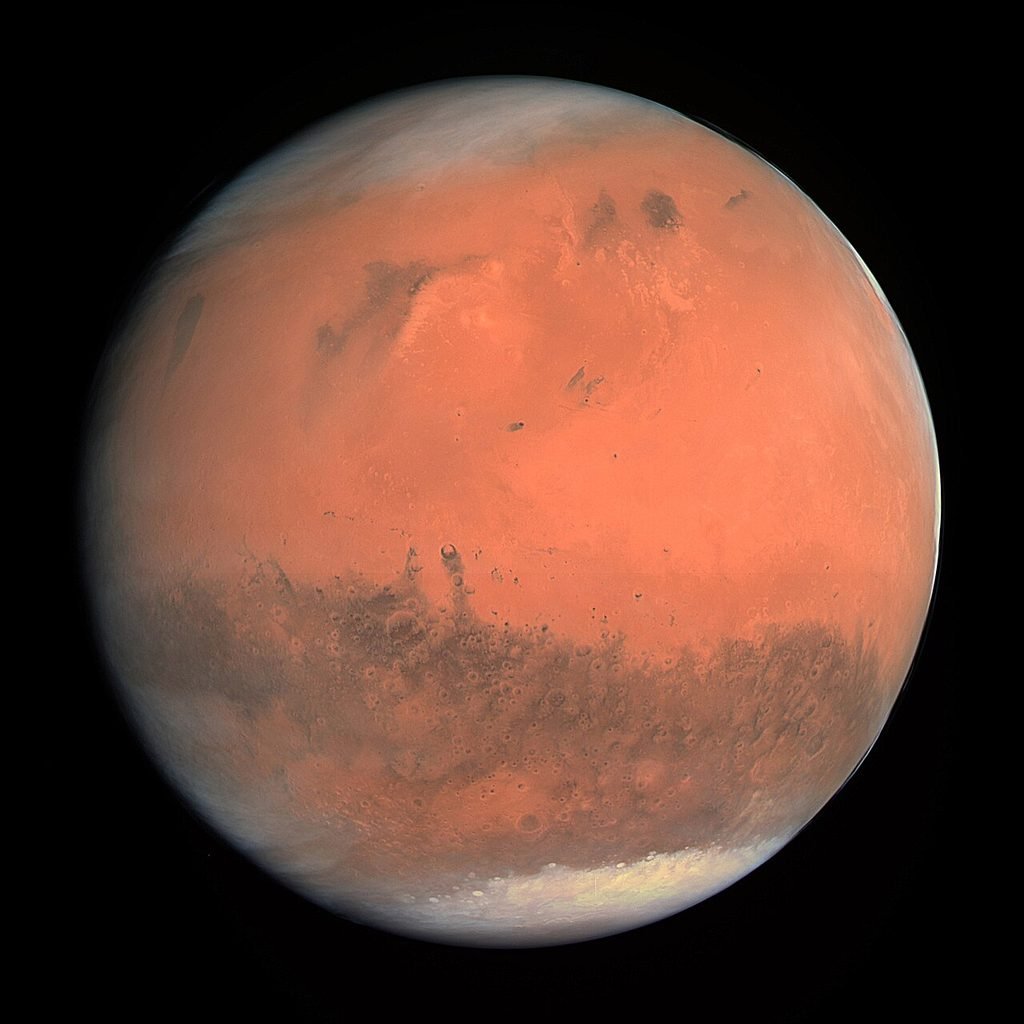
The most iconic visual characteristic of this world is undoubtedly its reddish-orange color. This striking appearance is caused by the ubiquitous presence of iron oxide—more commonly known as rust—in the fine dirt and dust that covers the surface, known as regolith. Over billions of years, the iron-rich rocks on the surface reacted with trace amounts of oxygen, literally rusting the entire planet and giving it the blood-red complexion that led ancient civilizations to name it after the god of war.
However, this rusty dust is not entirely static. The atmosphere, while incredibly thin (only about 1% the density of Earth’s at sea level), is highly dynamic and capable of producing terrifying weather phenomena. Solar heating creates strong thermal winds that frequently whip the fine iron dust into the air, creating localized dust devils and storms.
Occasionally, usually during the southern hemisphere’s summer when the planet is closest to the Sun, these localized storms can grow exponentially, merging together to form massive global dust storms. These apocalyptic storms can completely engulf the entire celestial body, blotting out the Sun and obscuring the surface from telescopes and orbiting satellites for weeks or even months at a time. These extreme storms pose a severe, life-threatening danger to solar-powered rovers.
3. Polar Ice Caps and the Ancient History of Water
When you look at this world through a decent amateur telescope, one of the first features you will likely notice are the brilliant white patches at the top and bottom of the planetary disk. These are the polar ice caps. Much like Earth, it possesses permanent ice caps at both its north and south poles.
However, the composition of these caps is uniquely alien. They are primarily made of water ice, but they are covered by a thick, seasonal layer of frozen carbon dioxide (dry ice). During the freezing winter months, the temperature drops so low that up to 30% of the entire carbon dioxide atmosphere literally freezes and falls to the ground as dry ice snow, causing the ice caps to visibly grow. When summer returns, the dry ice undergoes sublimation (turning directly from a solid into a gas), shrinking the visible ice caps and thickening the atmosphere.
While the surface today is a freezing, barren desert bathed in lethal ultraviolet radiation, geological evidence overwhelmingly suggests a very different past. Orbiters and rovers have discovered ancient, dried-up riverbeds, massive flood channels, delta formations, and minerals that can only form in the presence of liquid water. Scientists believe that roughly 3.5 billion years ago, it possessed a much thicker atmosphere and a strong magnetic field, allowing deep, liquid water oceans to cover large portions of its northern hemisphere. When its core cooled and the magnetic field died, the solar wind stripped away the thick atmosphere, causing the oceans to slowly evaporate and freeze underground.
4. Land of Giants: Towering Volcanoes and Deep Canyons
Because planet Mars is smaller than Earth and its interior cooled much faster, its tectonic activity effectively ceased billions of years ago. On Earth, tectonic plates constantly move over hot spots in the mantle, creating chains of smaller volcanoes (like the Hawaiian Islands). But here, the crust remained stationary over the mantle hot spots, allowing lava to erupt and pile up in the exact same location for hundreds of millions of years.
This lack of plate tectonics resulted in the formation of Olympus Mons, the absolute largest volcano in the entire solar system. This monstrous shield volcano stands a staggering 21.9 kilometers (13.6 miles) high—nearly three times the height of Mount Everest—and its base is roughly the size of the entire state of Arizona.
Not far from this volcanic giant lies Valles Marineris, an immense canyon system that makes the Grand Canyon look like a tiny ditch. Stretching over 4,000 kilometers long, 200 kilometers wide, and up to 7 kilometers deep, this colossal tectonic crack is as long as the entire United States. If placed on Earth, it would stretch all the way from New York to Los Angeles.
5. The Doomed and Escaping Moons: Phobos and Deimos
Unlike the inner planets Mercury and Venus, this world possesses natural satellites. However, they are nothing like our large, spherical Moon. It is orbited by two tiny, irregularly shaped moons named Phobos (meaning “Fear”) and Deimos (meaning “Dread” or “Panic”).
These moons are heavily cratered, potato-shaped chunks of rock. Most astronomers believe they are actually ancient asteroids that wandered too close from the nearby asteroid belt and were permanently captured by the planet’s gravitational pull.
Their orbital mechanics are as fascinating as their shapes. Deimos, the smaller and outermost moon, orbits relatively far away and is gradually spiraling outward, slowly escaping the planet’s gravitational grip. On the other hand, Phobos, the larger and innermost moon, orbits incredibly close to the surface—just 6,000 kilometers above the ground. Phobos orbits so fast that it actually rises in the west and sets in the east, crossing the sky twice a day. However, Phobos is doomed. Tidal gravitational forces are slowly pulling it closer to the planet at a rate of about 1.8 meters every hundred years. In roughly 50 million years, Phobos will either crash into the surface with catastrophic force or, more likely, be torn apart by extreme gravitational stress, creating a spectacular, Saturn-like rocky ring system around the planet.
6. The Unprecedented Robotic Exploration of the Red World
No other celestial body in the solar system has received as much attention, funding, and robotic visitors as this red world. However, getting there is notoriously difficult; roughly half of all historical missions have failed, earning it the grim nickname “the spacecraft graveyard.”
Despite the high failure rate, the 21st century ushered in a golden era of robotic rovers. The twin solar-powered rovers, Spirit and Opportunity, spent years finding conclusive chemical evidence of ancient water. However, both met dramatic ends. Spirit became permanently trapped in a sand pit, forcing NASA to officially declare its mission over in May 2011. Opportunity incredibly survived until 2018, when a massive, three-month-long global dust storm completely blocked the sunlight from its solar panels. Its historic mission officially concluded on February 12, 2019 (Sol 5,498).
To overcome the fatal vulnerabilities of solar panels, the next generation was built much larger and powered by nuclear energy. The Curiosity rover—a massive, Jeep-sized machine costing roughly $2.5 billion—launched in late 2011 and successfully landed on August 6, 2012. Powered by a nuclear radioisotope thermoelectric generator, it continues to analyze the complex organic chemistry of Gale Crater to this day.
The exploration fleet expanded further in the early 2020s. NASA’s Perseverance rover launched on July 30, 2020, and made a spectacular touchdown in Jezero Crater on February 18, 2021, tasked with collecting rock core samples for a future return to Earth. Accompanying Perseverance was the Ingenuity helicopter, which made aerospace history. Shortly after, the international presence grew when China’s Tianwen-1 mission successfully landed the Zhurong rover in the vast Utopia Planitia on May 15, 2021.
People often wonder if these various active rovers will ever cross paths and meet. Unfortunately, a robotic rendezvous is practically impossible. Given their agonizingly slow top speeds of just 4 to 5 centimeters per second, the vast continental distances between them, and the constant threat of communication delays and debilitating dust storms, these robotic pioneers will continue their solitary explorations far apart from one another.
7. The Ultimate Question: Is There Extraterrestrial Life?
The driving force behind this relentless exploration is the search for extraterrestrial life. We know that billions of years ago, this world had all the necessary ingredients for life as we know it: liquid water, organic molecules, and a stable climate.
The current scientific consensus is that if life ever did emerge here, it likely remained in the form of simple, microscopic, single-celled organisms. When the atmosphere was stripped away and the surface became a heavily irradiated, freezing desert, any surviving microbes would have been forced to migrate deep underground, where geothermal heat and subterranean aquifers of briny liquid water might still exist today. Radar instruments on orbiting satellites have already detected the presence of massive liquid water lakes buried deep beneath the southern polar ice cap, raising thrilling possibilities.
The Perseverance rover is currently exploring the Jezero Crater, an ancient river delta that is considered one of the best places to hunt for fossilized biosignatures of ancient microbial life. If we eventually find definitive proof that life independently evolved here, it would fundamentally shift our philosophical understanding of the universe, proving that life on Earth is not a miraculous, one-off anomaly.
8. Observing Planet Mars and Looking to the Future
For amateur astronomers, observing this rusty world through a telescope is an incredibly rewarding experience, especially during a period known as “opposition.” This occurs approximately every 26 months when Earth overtakes its neighbor in orbit, bringing the two planets exceptionally close together. During a favorable opposition, the planetary disk appears large and brilliantly bright in the eyepiece, allowing stargazers to easily spot the white polar ice caps and the darker, contrasting surface features like Syrtis Major.
As we continue to observe and explore, the dream of human colonization is rapidly shifting from science fiction to imminent reality. Both government space agencies like NASA and private aerospace companies like SpaceX are actively developing the massive starships and life-support technologies required to transport humans across the interplanetary void. While the challenges of radiation, toxic soil, and the lack of breathable air are incredibly daunting, the possibility of seeing human footprints pressed into the red dust within our lifetime remains one of the most inspiring goals in modern spaceflight.
Until that historic day arrives, we will continue to point our telescopes and send our robotic emissaries to unlock the crimson secrets of our most fascinating cosmic neighbor.
Leave a Reply