When amateur astronomers point their telescopes toward the outer reaches of the solar system, they are often met with a profoundly humbling sight. I vividly remember manually tracking this distant world through my own telescope. Unlike the detailed, swirling cloud bands of Jupiter or the breathtaking, majestic rings of Saturn, the seventh rock from the Sun appeared to me simply as a tiny, pale blue dot hovering in the inky blackness of space. It is incredibly difficult to observe, but that faint blue speck represents one of the most bizarre and scientifically fascinating worlds ever discovered.
As the third-largest planetary body in our solar system, planet Uranus is classified not as a gas giant, but as an “ice giant.” It is a world of extreme anomalies, featuring an atmosphere that defies thermal logic, a completely sideways rotation, a massive but wildly off-center magnetic field, and a dark, ghostly ring system discovered entirely by accident. In this incredibly comprehensive guide, we will explore the freezing atmospheric composition, the mystery of its internal heat, the chaotic history of its icy moons, and the historic robotic flyby that forever changed our understanding of this cold, distant world.
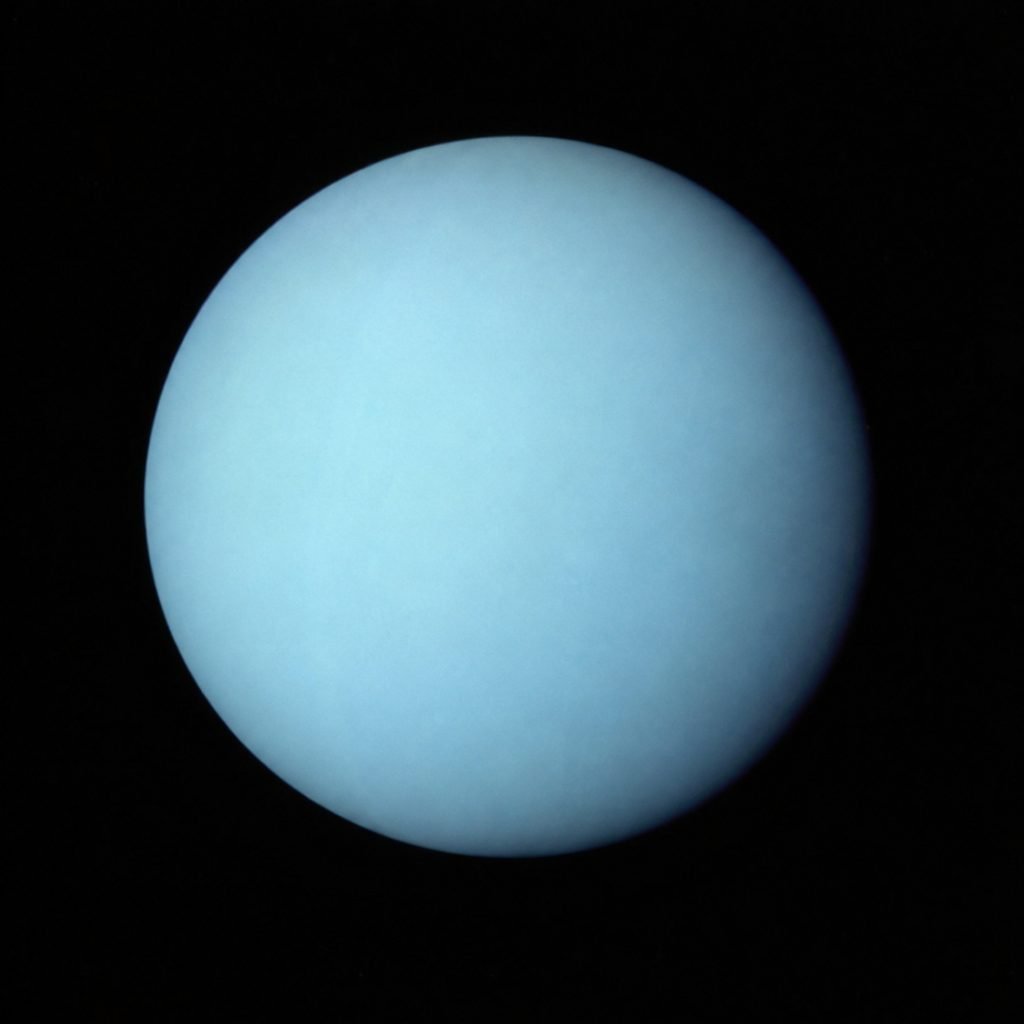
1. Core Specifications and the Ice Giant Composition
To truly understand this bizarre outer world, we must first examine its fundamental physical and orbital numbers. It resides in the frigid, dimly lit outskirts of the solar system, far beyond the warmer, rocky inner planets.
Here are the detailed physical specifications that define this cold, pale blue giant:
| Feature | Specification Details |
| Equatorial Diameter | 51,118 km (Roughly 4 times Earth’s diameter) |
| Mass | Approximately 14.5 times the mass of Earth |
| Average Density | 1.27 g/cm³ (Slightly denser than liquid water) |
| Atmospheric Composition | 83% Hydrogen, 15% Helium, 2% Methane |
| Average Temperature | -215°C (The coldest planetary atmosphere in the solar system) |
| Orbital Period (Year) | 84 Earth years |
| Rotation Period (Day) | -17 hours, 14 minutes (Retrograde, spinning backwards) |
| Axial Tilt | 97.77 degrees (Orbiting completely on its side) |
Unlike Jupiter and Saturn, which are composed almost entirely of hydrogen and helium, the internal structure of this world is vastly different. While it has a thick, gaseous outer atmosphere, astronomers theorize that the crushing internal pressure is not high enough to convert hydrogen into liquid metal. Instead, beneath the atmosphere lies a massive, slushy, churning mantle composed of “icy” materials—specifically water, ammonia, and methane. At the very center, there is likely a small, dense, rocky core roughly the mass of Earth.
2. A Pale Blue Atmosphere and the Missing Internal Heat
When observed through powerful telescopes, the most distinctive feature of this world is its smooth, featureless, aquamarine color. This beautiful pale blue hue is a direct result of its atmospheric composition. The upper atmosphere contains about 2% methane gas. As sunlight hits the atmosphere, the methane absorbs the red portion of the light spectrum while reflecting the blue and green portions back out into space, giving the planet its signature cyan appearance. Deep beneath the methane layer, highly reflective clouds of ammonia and hydrogen sulfide likely exist.
However, the most puzzling aspect of this atmosphere is its temperature. Despite being closer to the Sun than Neptune, its atmosphere is actually the absolute coldest in the entire solar system, dropping to a freezing -215°C. Jupiter, Saturn, and Neptune all radiate significantly more heat into space than they receive from the Sun, indicating a powerful internal heat source. In stark contrast, this planet emits almost no excess internal heat. Astronomers believe that a catastrophic collision during the planet’s formation may have expelled most of its primordial internal heat, or perhaps a unique barrier in its upper layers prevents the core’s heat from escaping to the surface.
3. The Bizarre Sideways Rotation of Planet Uranus
Perhaps the most famous and baffling characteristic of this ice giant is its extreme axial tilt. While most planets spin like tops roughly perpendicular to the plane of their orbit, this world orbits completely rolled over on its side. Its equator is tilted at a staggering 97.77 degrees relative to its orbital plane. Furthermore, like Venus, it rotates backwards (retrograde) compared to the majority of the solar system, taking about 17 hours to complete a single day.
This extreme sideways tilt creates the most bizarre and extreme seasons in the planetary system. Because it takes 84 Earth years to orbit the Sun, each pole gets bathed in continuous, unrelenting sunlight for 42 years, followed by 42 years of complete, freezing darkness.
Determining this 17-hour rotation period was historically difficult for astronomers. Because the planet was tilted over and lacked distinctive cloud features, tracking its spin using the Doppler effect from Earth was incredibly challenging and yielded wildly conflicting results. It wasn’t until a robotic spacecraft physically arrived and measured the rotating magnetic field that the true length of its day was finally confirmed. But why is it tilted? The leading scientific theory is that shortly after its formation, an Earth-sized protoplanet violently crashed into it, completely knocking the entire world onto its side.
4. The Off-Center Magnetic Field
The anomalies continue deep into the planet’s magnetosphere. Because it lacks a deep ocean of liquid metallic hydrogen, its magnetic field is not generated in the core like Jupiter or Earth. Instead, it is generated by electrical currents flowing in the slushy, pressurized ocean of water and ammonia deep within the icy mantle.
This unique generation method results in a highly erratic magnetic field. The magnetic axis is tilted an incredible 59 degrees away from the planet’s axis of rotation. Even more bizarrely, the magnetic field does not originate from the geometric center of the planet; it is shifted off-center by about a third of the planet’s radius toward the south pole. As the planet rolls on its side, this lopsided, wobbling magnetic field creates a twisted, corkscrew-shaped magnetotail trailing behind it in space. While the magnetic field is strong enough to trap high-energy charged particles in radiation belts, it was not strong enough to be detected from Earth until a spacecraft flew through it.
5. The Accidental Discovery of the Dark Rings
For nearly two centuries after the discovery of planet Uranus, astronomers believed this ice giant was completely solitary. That changed in 1977 during a routine observation of stellar occultation. Astronomers were watching the planet pass in front of a distant background star to study its atmosphere. However, before the planet itself blocked the star, the starlight unexpectedly dimmed and flickered several times. After the planet passed, the exact same flickering pattern occurred on the other side.
This brilliant deduction revealed that the planet was surrounded by a system of narrow, completely unobserved rings. Ground-based observations eventually confirmed nine distinct rings, with more discovered later by the Hubble Space Telescope and robotic probes.
Why weren’t they seen earlier? Unlike Saturn’s brilliant, icy rings, which reflect almost all sunlight, these rings are incredibly dark and faint. They reflect only about 1% of the sunlight that hits them. They are composed primarily of macroscopic rocky boulders, coarse dust, and small amounts of pitch-black, radiation-darkened water ice. The extreme darkness of these rings makes them roughly as reflective as lumps of coal.
6. The Major Moons: A Shakespearean Collection
While it possesses over two dozen known natural satellites (all uniquely named after characters from the works of William Shakespeare and Alexander Pope), there are five major moons that dominate the system: Miranda, Ariel, Umbriel, Titania, and Oberon.
The two largest, Titania and Oberon, were discovered by William Herschel in 1787. Titania is the largest in the system, with a diameter of 1,580 kilometers, while the heavily cratered Oberon orbits the furthest out at roughly 583,000 kilometers. A century later, William Lassell discovered Ariel and Umbriel. Ariel is the brightest moon in the system and appears to have the youngest surface, heavily scarred by deep canyons. Umbriel, on the other hand, is the darkest and most ancient of the five, featuring a surface saturated with massive, old impact craters.
7. The Shattered and Reassembled Moon: Miranda
Of all the moons orbiting planet Uranus, none is more scientifically baffling or visually striking than Miranda. Discovered in 1948 by Gerard Kuiper, Miranda is the smallest and innermost of the five major moons, with a diameter of just 480 kilometers.
When high-resolution images of Miranda were finally beamed back to Earth, astronomers were absolutely stunned. The surface looked like a chaotic, mismatched jigsaw puzzle that had been haphazardly glued together. It features heavily cratered ancient terrain sitting directly next to massive, grooved cliffs (coronae) and canyons that are up to 20 kilometers deep—some of the deepest in the entire solar system.
The bizarre, distorted topography of Miranda led astronomers to a terrifying hypothesis. They believe that in the distant past, Miranda suffered a cataclysmic impact from a massive asteroid that completely shattered the tiny moon into pieces. However, instead of dispersing into a ring, the gravitational pull of the fragments caused them to slowly fall back together and re-coalesce, freezing into the chaotic, jumbled, and deformed Frankenstein-like world we see today. Another competing theory suggests that extreme tidal heating from the host planet partially melted the interior, causing the surface to buckle and crack violently.
8. The Historic Flyby of Voyager 2
Because of the immense distance, exploring this cold, pale blue dot is incredibly difficult. To date, only one human-made object has ever visited it. Launched in 1977, NASA’s Voyager 2 spacecraft embarked on an epic “Grand Tour” of the outer solar system.
After traveling for nearly a decade, Voyager 2 finally made its closest approach on January 24, 1986, skimming just 81,500 kilometers above the cloud tops. The data and photographs beamed back during those few precious hours were 300 times more detailed than anything ever seen from Earth. In that brief encounter, humanity learned more about this ice giant than we had in the previous 200 years since its discovery.
Voyager 2 discovered 10 new small moons, mapped the newly found dark ring system, confirmed the bizarre 17-hour sideways rotation, and made the perplexing discovery that the planet’s equator is actually colder than its sunlit poles—an anomaly that remains unexplained to this day. As we look to the future, the planetary science community is desperately pushing for a dedicated flagship orbiter mission to return to this tilted, freezing world. Until that new robotic emissary arrives, the incredible legacy of Voyager 2 remains our only close-up view of this beautiful, mysterious, and sideways ice giant.
Leave a Reply