Whenever stargazers set up their equipment under a clear night sky, there is always one celestial target that draws the most gasps of absolute wonder. While Jupiter impresses with its sheer size and Mars with its deep crimson color, nothing compares to the breathtaking beauty of the ringed giant. I will never forget the first time I pointed my own telescope at this distant world. Although the image in the eyepiece was small, seeing that perfect, delicate ring completely separated from the main globe was a profoundly moving experience. It immediately transformed a tiny point of light into a massive, tangible world.
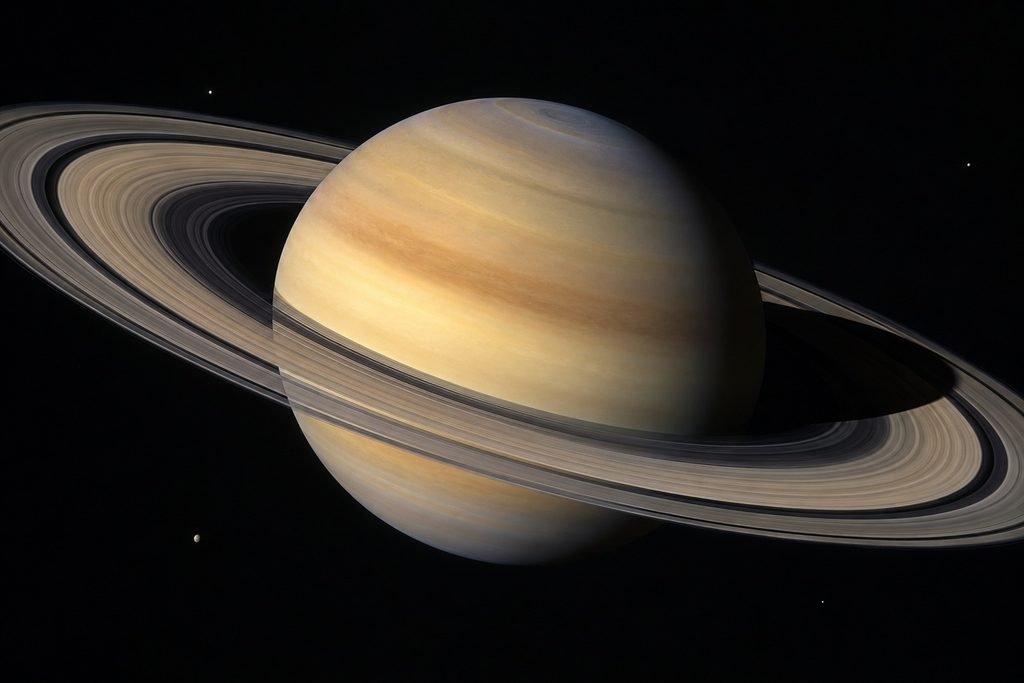
As the sixth rock from the Sun and the second-largest gas giant, planet Saturn is the undeniable jewel of our solar system. Beyond its stunning visual appeal, it is a highly dynamic and scientifically fascinating world featuring a bizarre internal structure, extreme weather systems, and a complex retinue of strange, ice-covered moons. In this highly comprehensive guide, we will explore its mind-boggling physical specifications, the mystery of its internal heat, the intricate mechanics of its legendary rings, and the tantalizing possibility of finding extraterrestrial life hidden deep within its bizarre natural satellites.
1. Core Specifications and Extreme Oblateness
To truly appreciate the uniqueness of this gas giant, we must first examine its fundamental physical and orbital numbers. It is a world composed almost entirely of gas and liquid, which gives it some highly unusual physical properties compared to the inner rocky planets.
Here are the detailed physical specifications that define this ringed giant:
| Feature | Specification Details |
| Equatorial Diameter | ~120,536 km (Roughly 9.5 times Earth’s diameter) |
| Mass | Approximately 95 times the mass of Earth |
| Average Density | 0.687 g/cm³ (The lowest density in the solar system) |
| Atmospheric Composition | Mostly Hydrogen and Helium, with traces of Methane and Ammonia |
| Surface (Cloud Top) Temp | Approximately -176°C |
| Orbital Period (Year) | 29.4 Earth years |
| Rotation Period (Day) | 10 hours, 39 minutes (Highly rapid rotation) |
| Axial Tilt | 26.7 degrees (Causing prominent seasonal changes) |
The most famous piece of trivia regarding this world is its remarkably low density. At just 0.687 g/cm³, it is actually less dense than liquid water. If you could somehow find a bathtub large enough to hold the entire solar system, this is the only planet that would physically float!
Because it is mostly composed of gas and rotates incredibly fast (completing a day in just over 10 hours), it experiences an extreme centrifugal force. This force causes the equator to bulge outward violently while the poles flatten inward. The result is an oblateness of 0.108, meaning the planet looks noticeably squashed and flattened like a thick pancake when viewed through a telescope.
2. A Muted Atmosphere and the Helium Rain Mystery
Like its larger neighbor Jupiter, the atmosphere here is highly structured into alternating bands (belts and zones) parallel to the equator. However, the colors are far more muted, appearing as soft, washed-out hues of yellow, brown, and pale gold. Because the planet is so far from the Sun (orbiting at a distance of about 1.4 billion kilometers), the upper atmosphere is freezing cold (-176°C). This extreme cold causes the ammonia clouds to form much deeper in the atmosphere, obscuring the colorful, turbulent weather systems lurking below.
While its weather appears calmer, it still experiences massive, albeit rare, atmospheric phenomena. Approximately once every 30 Earth years (one Saturnian year), a colossal weather system known as a “Great White Spot” erupts, spreading bright, turbulent white clouds across the entire northern hemisphere.
One of the greatest scientific mysteries regarding this world is its internal heat. Just like Jupiter, it emits significantly more thermal energy into deep space than it receives from the Sun. However, simple gravitational contraction cannot fully explain this massive energy output. Modern astrophysicists believe the answer lies in a bizarre meteorological phenomenon known as “helium rain.” Deep within the atmosphere, the temperatures and pressures cause helium gas to condense into liquid droplets. Because helium is heavier than hydrogen, these liquid droplets slowly rain down through the surrounding metallic hydrogen fluid toward the core. The immense friction generated by this continuous, planet-wide helium rainfall releases massive amounts of thermal energy, powering the fierce jet streams in the upper atmosphere.
3. The Interior Structure and Magnetic Field
Beneath the freezing cloud tops of planet Saturn, the internal structure is assumed to be very similar to Jupiter’s. As you descend, the crushing pressure forces the dominant hydrogen gas into a dense, liquid state. Even deeper, the pressure becomes so unimaginable that the hydrogen molecules are crushed into highly conductive “liquid metallic hydrogen.” Finally, at the absolute center, scientists hypothesize there is a solid, dense core composed of rock and exotic ices.
This rapidly spinning ocean of liquid metallic hydrogen acts as a massive planetary dynamo, generating a powerful global magnetic field. While this magnetic field is somewhat weaker than Jupiter’s, it is still immense and highly dynamic. When the solar wind is particularly strong, the magnetic bubble (magnetosphere) is compressed to about 20 times the planet’s radius. When the solar wind weakens, the magnetosphere dramatically expands outward past 30 planetary radii. Just like on Earth and Jupiter, the interaction between the solar wind and this magnetic field creates beautiful, glowing auroras near the planet’s poles.
4. The Legendary Ring System of Planet Saturn
What truly sets this world apart from every other celestial body is its majestic, incredibly complex ring system. The rings were first observed by Galileo Galilei in 1610, but his primitive telescope couldn’t resolve the shape; he famously described the planet as having “ears.” It wasn’t until 1655 that Dutch astronomer Christiaan Huygens used a superior telescope to correctly identify a flat, detached ring circling the globe.
Thanks to the robotic Voyager 1 and 2 probes, and later the magnificent 13-year Cassini mission, we now know that the rings are not solid, flat sheets. Instead, they are composed of billions of individual chunks of highly reflective, nearly pure water ice, with a small mixture of rocky dust. These glittering ice particles range in size from tiny grains of sand to massive, tumbling boulders the size of houses.
The ring system is breathtakingly wide, stretching hundreds of thousands of kilometers into space, yet it is astonishingly thin. In most places, the main rings are only about 10 meters (30 feet) thick! Because the planet is tilted on its axis by 26.7 degrees, the rings appear to slowly tilt up and down from our perspective on Earth as the planet makes its 29.4-year journey around the Sun. About every 15 years, the rings become perfectly edge-on to our line of sight, causing them to seemingly vanish entirely from telescopes for several weeks.
5. A Chaotic Origin: The Formation of the Rings and Moons
The exact origin of these brilliant rings remains a topic of intense scientific debate. For decades, astronomers believed the rings were primordial—formed 4.6 billion years ago from the leftover dust that originally created the planet. However, recent data collected by the Cassini spacecraft during its final, dramatic plunge into the atmosphere suggests a much more violent and recent history.
Many scientists now theorize that the rings are no older than 100 million years. They are likely the shattered, frozen remains of a massive, ice-rich moon that wandered too close to the planet and was ripped to shreds by immense tidal gravitational forces.
This violent history extends to the planet’s massive retinue of dozens of natural satellites. Unlike the rings, which are pure ice, most of the moons are a dirty mixture of rock and ice. Astronomers have noticed a fascinating pattern: the larger moons generally have heavily altered surfaces, suggesting active internal heating that erased old impact craters. In contrast, the smaller moons are heavily cratered, frozen, and dead. This suggests that the current satellite system is the chaotic result of numerous ancient moons violently crashing into one another, shattering, and slowly re-coalescing over billions of years.
6. Titan: A World Shrouded in Mystery and Methane
Among the dozens of icy satellites, one absolutely massive moon stands out as one of the most scientifically important destinations in the entire solar system: Titan.
Titan is the second-largest moon in the solar system (second only to Jupiter’s Ganymede) and is actually larger than the planet Mercury. Discovered in 1655 by Christiaan Huygens, it holds a unique distinction: it is the only moon in the solar system known to possess a dense, substantial atmosphere. In 1944, astronomer Gerard Kuiper discovered that this thick, opaque atmosphere was rich in methane. Today, we know the atmosphere is mostly nitrogen, laced with methane, argon, and complex organic hydrocarbons.
Because the atmosphere is so thick and the surface temperature is so bitterly cold (-180°C), Titan is the only place besides Earth known to have stable bodies of liquid on its surface. However, these are not oceans of water. Titan features a bizarre, alien hydrological cycle where liquid methane and ethane evaporate into the sky, form clouds, and rain back down, creating massive liquid hydrocarbon lakes and carving deep river valleys across the icy surface. Because Titan possesses organic molecules and liquid solvents, astrobiologists consider it a prime candidate for hosting exotic, methane-based microbial life.
7. The Bizarre Moons: Iapetus, Dione, and Phoebe
Beyond Titan, the robotic exploration of planet Saturn has revealed a bizarre and highly diverse collection of smaller icy moons.
Between 1671 and 1684, Italian astronomer Giovanni Cassini discovered several critical moons, including Iapetus, Tethys, and Dione. Iapetus, in particular, is a geological anomaly. It features a stark, dramatic “two-tone” coloration; one hemisphere is as bright as fresh snow (pure ice), while the trailing hemisphere is as dark as charcoal (coated in dark, reddish dust). Dione, orbiting the planet every 2.7 days, features massive, bright ice cliffs created by tectonic fracturing.
Another strange outlier is Phoebe, discovered in 1898 by American astronomer William Pickering. Orbiting at a massive distance of 13 million kilometers and taking 550 days to complete a single orbit, Phoebe rotates backward (retrograde) compared to the other moons. Astronomers believe Phoebe is actually a dark, ancient object captured from the distant Kuiper Belt. Lastly, the small moon Mimas is famous for possessing an absolutely massive impact crater named Herschel, which covers nearly a quarter of its entire surface area, making the moon look exactly like the Death Star from Star Wars.
8. Looking to the Future: The Search for Enceladus
While Titan offers the promise of exotic methane-based biology, another tiny, bright moon named Enceladus has captured the immediate attention of astrobiologists. In 2005, the Cassini spacecraft made a historic discovery: Enceladus is actively firing massive geysers of salty liquid water and organic molecules out of deep fractures at its south pole, directly into space.
These geysers conclusively prove that this tiny moon harbors a massive, warm, liquid water ocean beneath its frozen crust, heated by tidal friction. Because it contains liquid water, organic chemistry, and a hydrothermal heat source, Enceladus is currently considered one of the most likely places in the universe to find active, Earth-like extraterrestrial life. As we continue to develop future robotic missions to dive through these watery plumes, the magnificent, ringed world and its incredible retinue of moons will remain at the very forefront of human exploration and scientific wonder.
Leave a Reply